By DoodleLearn · Evidence-informed guide
A math coloring worksheet is useful when the mathematical task is clear and the colors help organize a response. A child might count a set, classify shapes, continue a pattern, or solve an addition problem before coloring an area. The color is a way to communicate or enjoy the result, not the source of mathematical understanding. Ask for reasoning as well as an answer.
This guide supports preschool, kindergarten, and Grades 1–4 with flexible suggestions. Students may be ready for different topics at different times; grade labels are planning aids rather than curriculum certification. A worksheet with easy visual spaces can still contain challenging arithmetic. Our gallery therefore shows visual complexity separately from the mathematical level.
Ten companions are available in A4 and US Letter. Worksheets that have determinate answers include an answer-key page; the numeral overview has no problem key because it is for recognition. The checked arithmetic covers addition and subtraction within twenty and multiplication facts up to sixteen. Existing catalog collections are linked only when their real records match; no full math learning pack is invented.
Coloring offers opportunities for practice and enjoyment. The research does not make every benefit certain, and coloring is not a substitute for instruction, therapy, or medical care.
Download Classroom PrintablesWhy combine math and coloring?
Color can mark categories, distinguish quantities, or make a short practice task more inviting. For example, students can color two circles and then two more while explaining the total, or use a repeated color pattern to communicate an underlying sequence. Those representations need conversation and checking; a finished page may conceal a misunderstanding.
Keep the objective separate from neatness. A child who explains a sum with rough marks may understand it better than one who follows another student’s color choices. Let students write a number, use a pattern, or speak their answer so success does not depend on color vision or fine motor precision. Offer an equivalent non-color response whenever useful.
Number recognition and counting
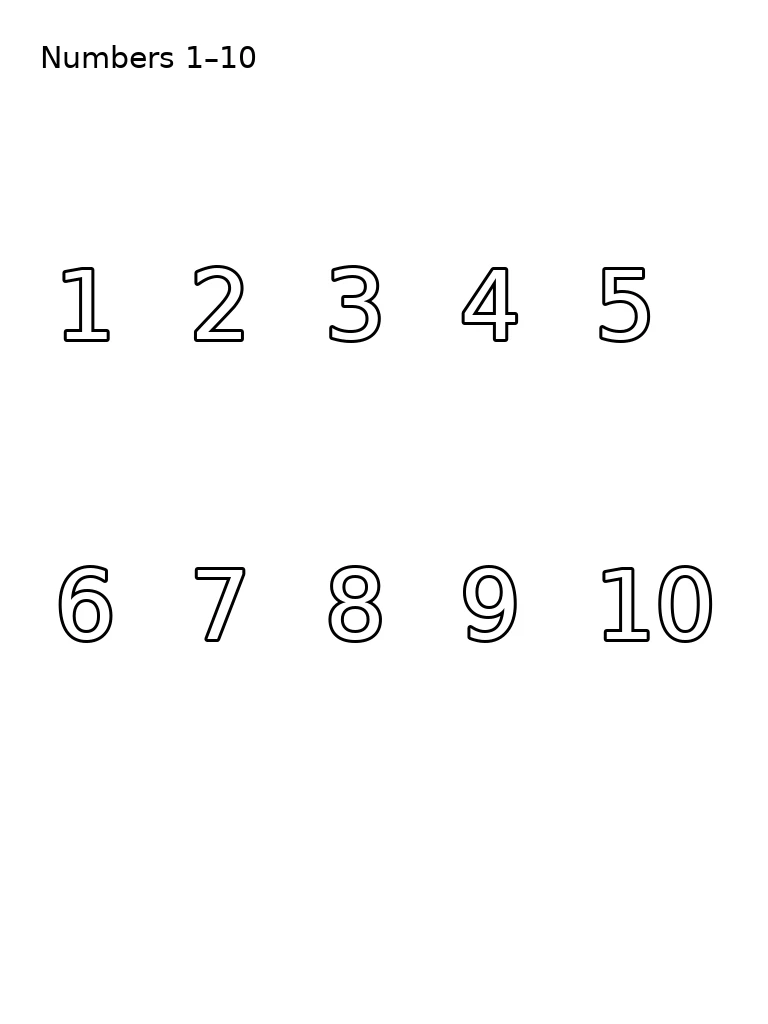
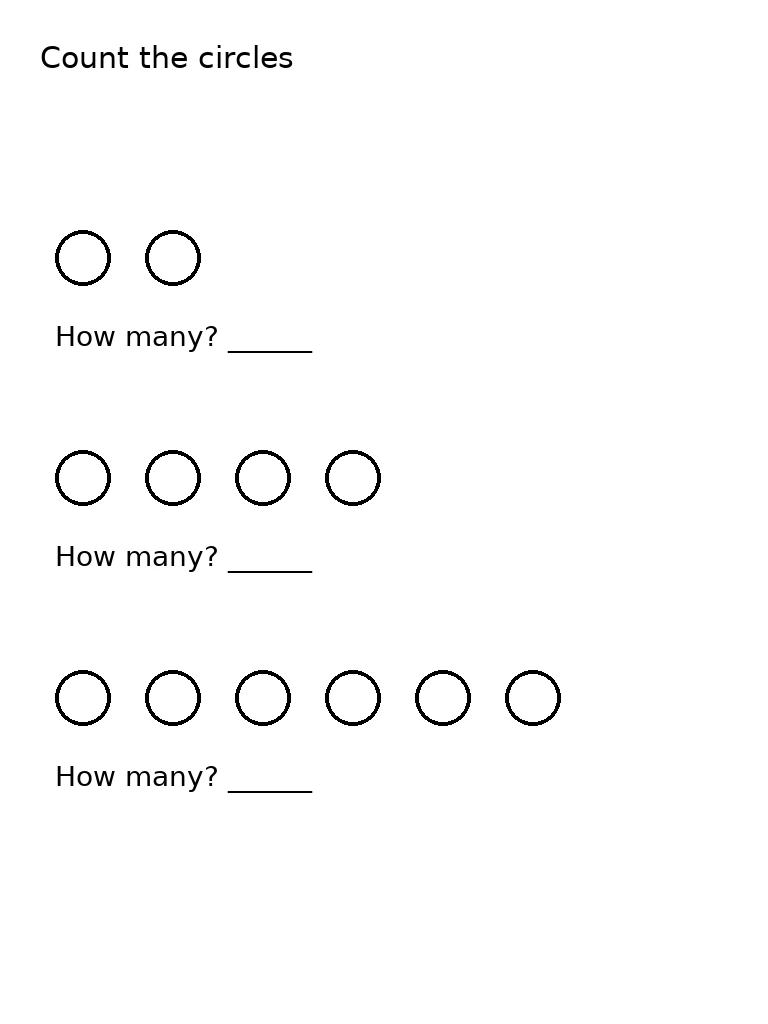
Use numerals 1–10 for a starting recognition task, then connect them with quantities. Our overview shows the symbols, while the counting page has rows of exactly two, four, and six circles. Touch each circle once while saying a number word, then state the total. This is different from reciting numbers without matching objects.
For numbers 11–20, build or draw a group of ten and some additional objects on blank paper. An adult can write the corresponding numeral and discuss the two-digit symbol. The companion set does not claim a separate printed 1–20 tracing page. Choose real counters safely and use drawings when small objects are inappropriate.
Check quantity matching by asking the student to show a set for a numeral, not just select a symbol after hearing its name. Rearrange the same objects and discuss whether the quantity changed. If an answer is incorrect, model one-to-one counting and invite another attempt without requiring a long series of repetitive pages.
Addition coloring worksheets
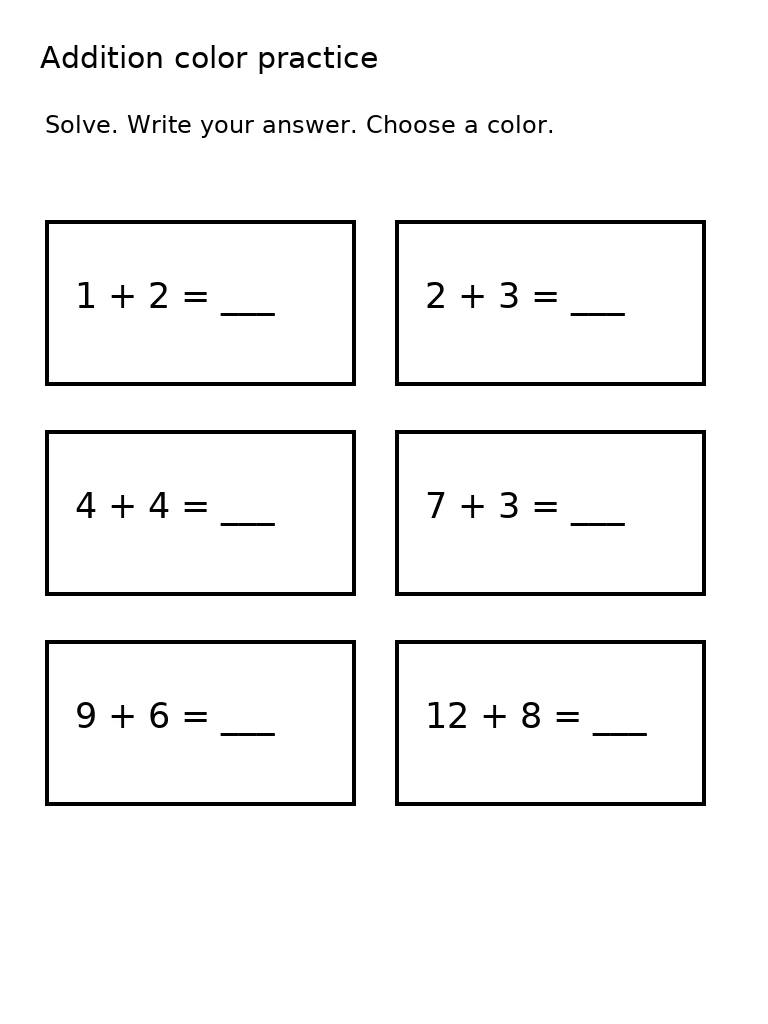
Begin with addition within five using objects, fingers, or drawings. Combine two visible sets and count the total. Move toward sums within ten and twenty when students can explain the representation. The addition companion includes 1 + 2, 2 + 3, 4 + 4, 7 + 3, 9 + 6, and 12 + 8, with checked answers on the second page.
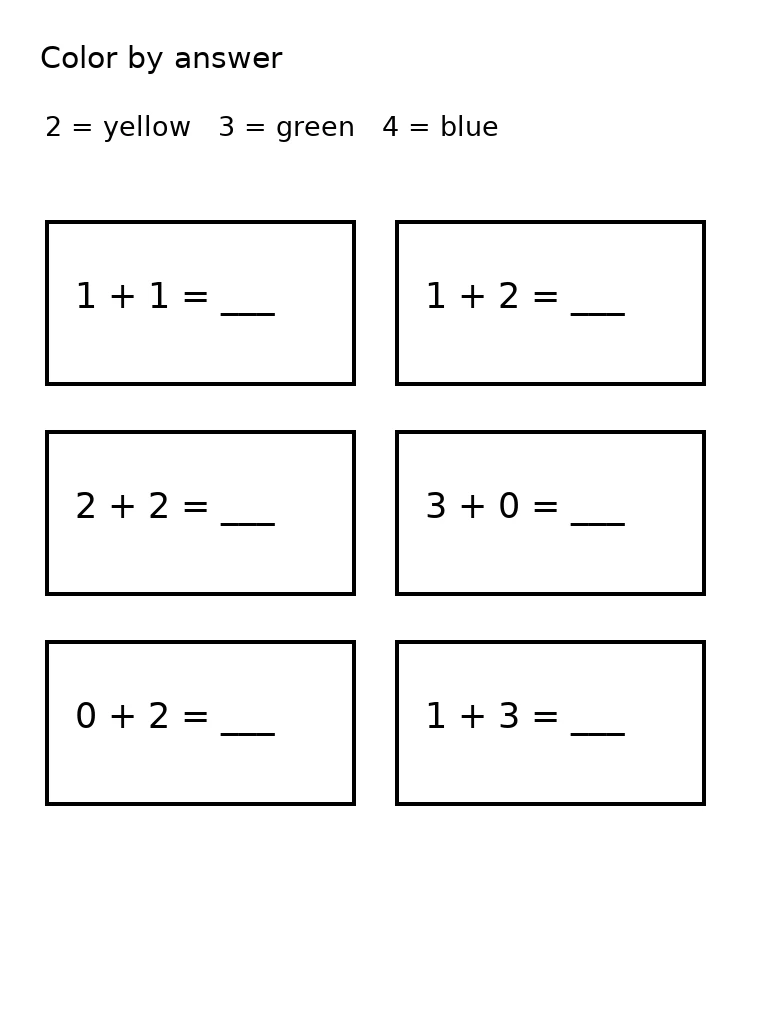
A color-by-answer task needs an unambiguous key. Our separate short key uses 2 = yellow, 3 = green, and 4 = blue. Every printed problem on that page gives one of those values, and no answer maps to conflicting colors. Read the key with the student, solve first, then select the color. Do not infer understanding from a recognizable final picture alone.
For a word problem, say “There are two crayons and we add three more. How many altogether?” Let the student draw or arrange the quantities, then write the expression with adult support. Avoid teaching only a keyword rule such as always adding when the word more appears; the situation and quantities determine the operation.
Subtraction coloring worksheets
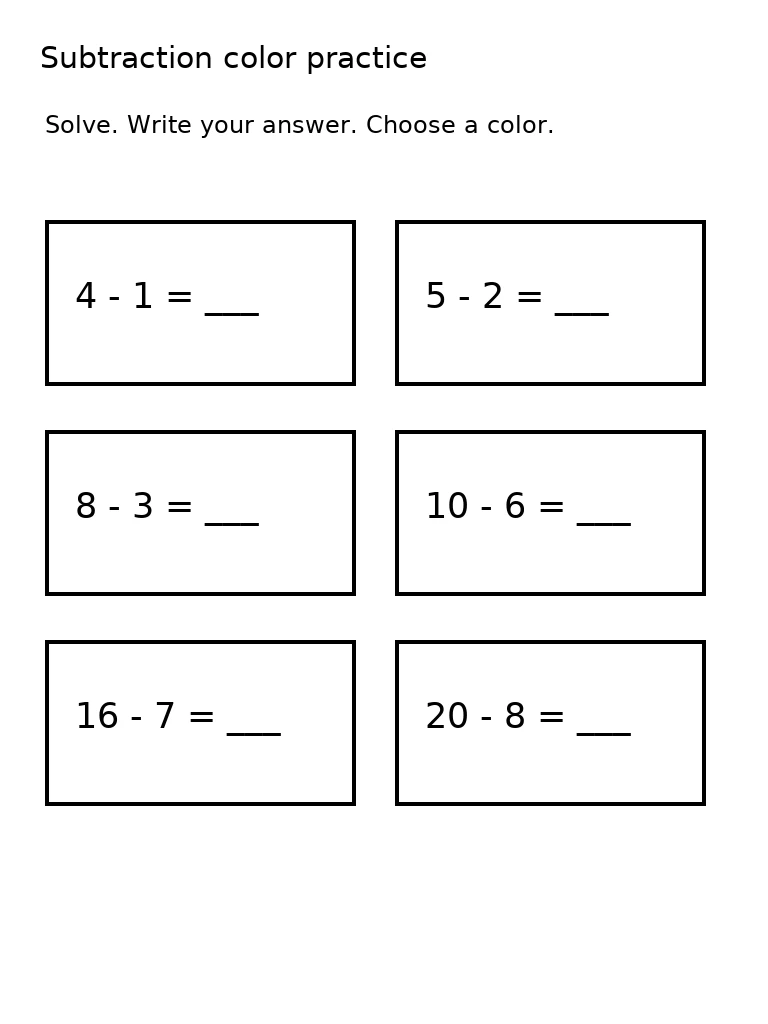
Subtraction can describe removing objects, finding a difference, or finding a missing part. Start with a visible set within five, remove a few, and explain what remains. Then compare two quantities rather than implying all subtraction stories must involve taking something away.
The subtraction companion contains 4 − 1, 5 − 2, 8 − 3, 10 − 6, 16 − 7, and 20 − 8. All answers are nonnegative and are included in the key. Use a number line or drawings for larger numbers if useful, and ask the learner to explain a strategy rather than complete the page under time pressure.
A simple word problem might involve eight seeds drawn on paper and three crossed out. Ask how many remain and how the expression describes the drawing. Another compares a group of eight with a group of three. Discuss the difference between the stories even though the same subtraction calculation can describe both.
Shapes and geometry
Compare circles, triangles, squares, and rectangles using visible attributes. A triangle has three straight sides; a square has four equal sides and four right angles. A rectangle has four right angles, and a square is a special rectangle. Avoid teaching “a square is not a rectangle” as a general mathematical rule.
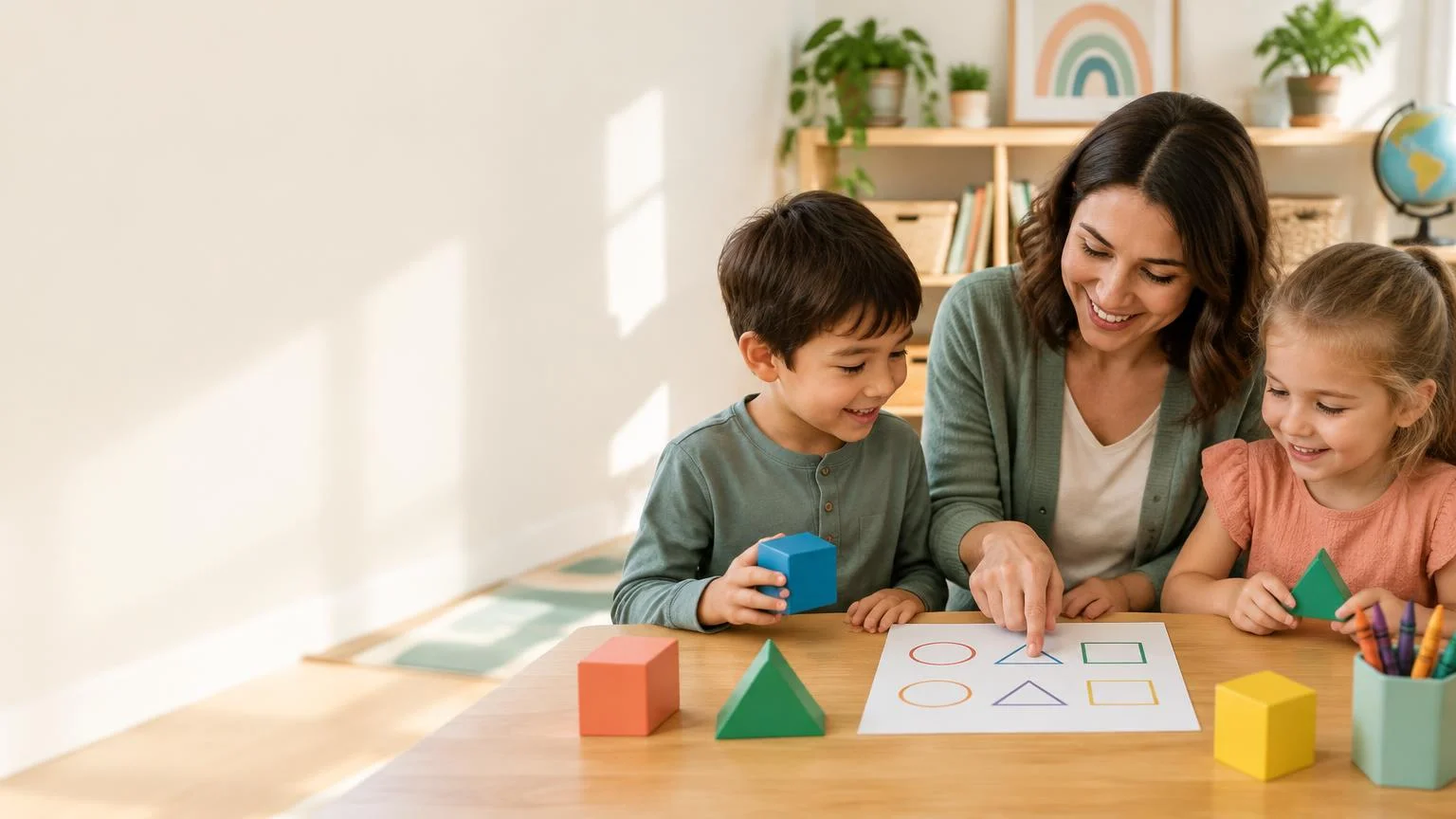
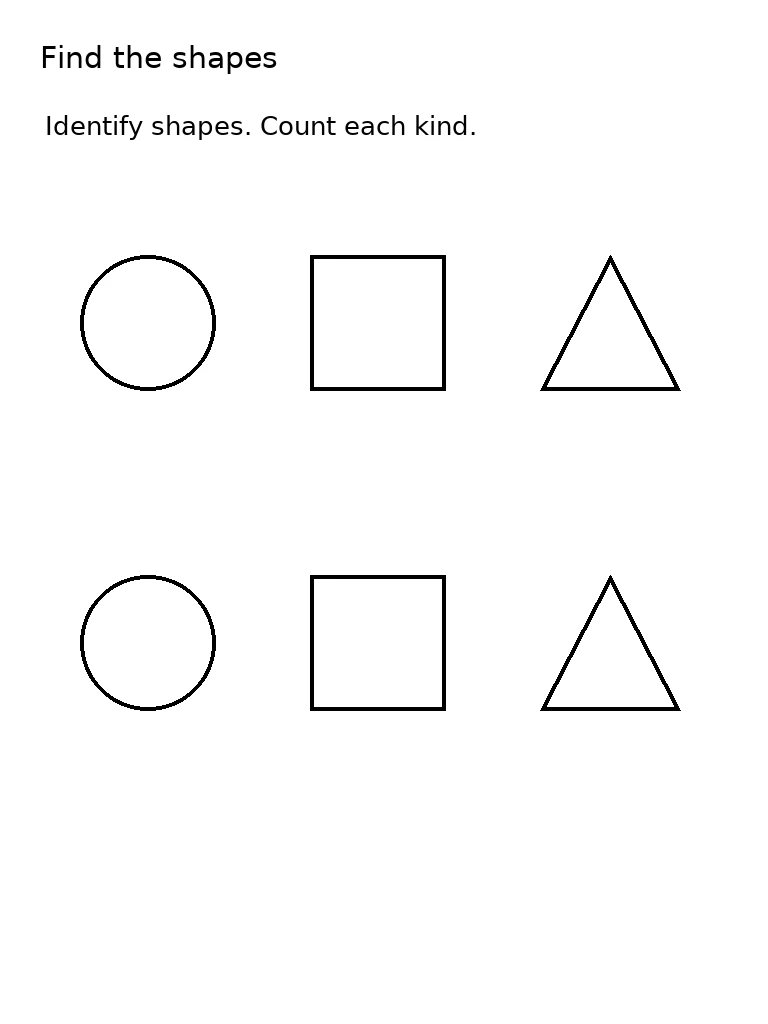
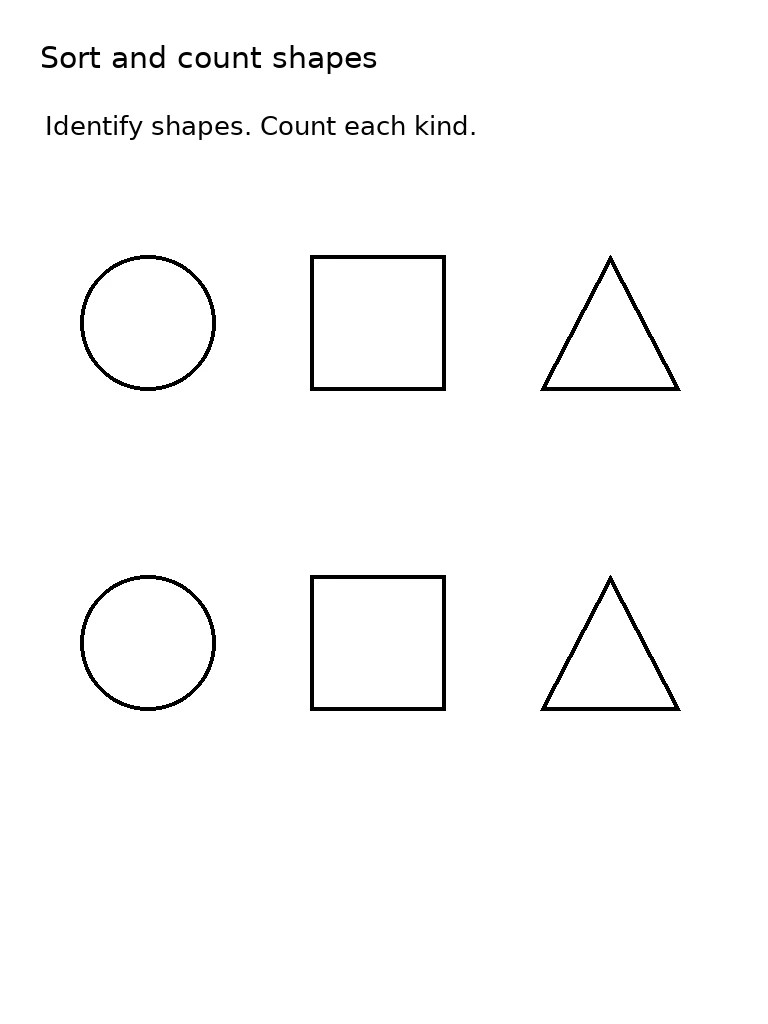
The shape companion shows two circles, two squares, and two triangles. Rectangles and other polygons can be drawn separately for discussion; they are not promised as extra figures on this sheet. Turn a paper shape and ask whether its category changes. Orientation and color do not change the number of sides or the defining attributes.
For basic polygons, compare the number of straight sides using adult-drawn examples or suitable objects. A circle is not a polygon. Match the vocabulary to the task, and avoid relying on a prototype such as only equilateral triangles. The drawing is an illustration; exact measurement needs a stated scale or measuring method.
Patterns and sequences
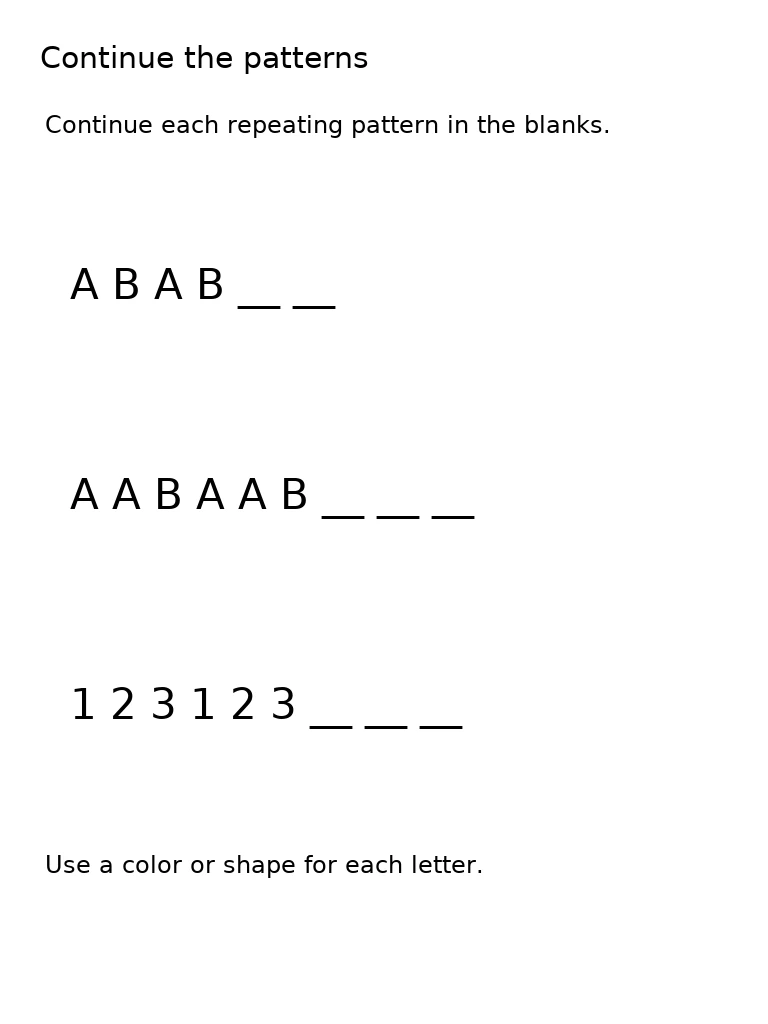
A repeating pattern has a unit that repeats. In ABAB, the unit is AB; in AABAAB, it is AAB. Ask students to identify the unit before continuing. The companion uses letters and numerals to describe three repeating sequences, with blank positions and checked continuations in the answer key.
Choose a color or shape to represent A and B, then carry the same rule through the row. Patterns can be communicated with symbols as well as color. The sequence 1 2 3 1 2 3 repeats; it is not a count-up sequence. Discuss this difference before assuming the next number after the printed 3 must be 4.
For number sequences such as 2, 4, 6, 8, state the intended rule clearly. A short sequence may fit more than one rule, so avoid treating every invented continuation as uniquely determined without context. Invite students to explain their rule and compare it with the rule the task specifies.
Multiplication coloring activities
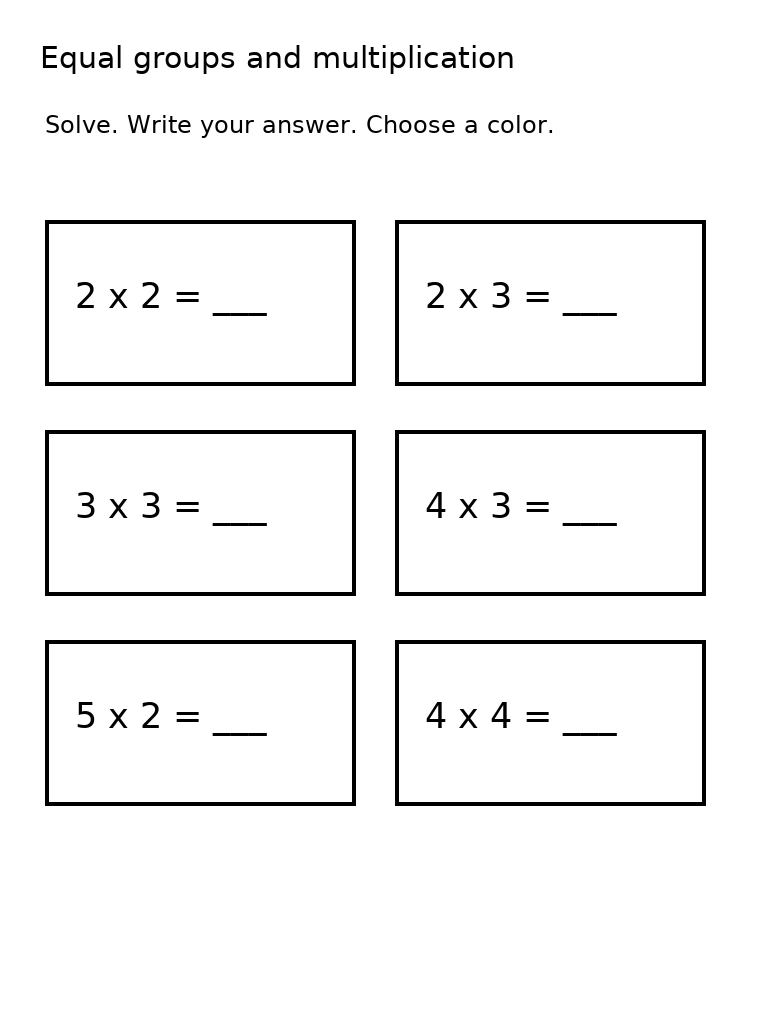
Introduce multiplication through equal groups when students are ready. Three groups of four have twelve objects; a drawing or array makes the quantities visible. Count groups and items per group before writing 3 × 4. This is different from placing unrelated numerals in colored boxes.
The multiplication companion includes 2 × 2, 2 × 3, 3 × 3, 4 × 3, 5 × 2, and 4 × 4. Answers are checked and printed on a separate key page. Students can draw matching arrays on blank paper, discuss strategies, and choose colors after solving. The worksheet is a small fact set, not a complete multiplication curriculum.
For a color-by-answer multiplication extension, an adult can write a new short key and verify every result before use. Do not call the existing addition-key page a multiplication puzzle: its problems are addition. Keep the operation, key, and stated objective aligned so the visual activity does not hide an incorrect claim.
Math coloring activities by grade
Preschool: compare small sets, point to numerals, and name broad shapes with adult support. Kindergarten: match quantities, count reliably, and explore simple repeating units. Grade 1: represent addition and subtraction with drawings and explain a solution. These are suggestions, not prerequisites that every student must meet on schedule.
Grade 2: work with quantities and calculations within twenty, discuss comparison subtraction, and begin equal groups when appropriate. Grade 3: connect arrays with multiplication facts, explain patterns, and classify shape attributes. Grade 4: compare strategies, justify rules, and extend a simple task with a written explanation rather than merely adding tiny coloring spaces.
The comparison companion offers separate counting, addition, subtraction, and multiplication prompts. Let students choose or receive an appropriate task without labeling one person easy and another advanced. A learner may need support with arithmetic but enjoy detailed art, or prefer broad art while solving sophisticated problems.
Ten classroom math coloring activities
Each activity names a suggested grade, objective, materials, procedure, answer-checking method, and actual printable. Offer spoken explanations, patterns, and non-color marking alternatives. Do not display answer keys during independent practice unless the activity is intended as a worked example.
- Count once — Preschool–Kindergarten. Objective: one-to-one counting. Materials: circle-counting companion and crayons. Touch each circle once, say the count, write or dictate the total, then color. Check: rows contain 2, 4, and 6. Resource: Count the circles and its key.
- Find a numeral — Preschool–Kindergarten. Objective: recognize symbols 1–10. Materials: numeral overview and large safe counters or drawings. Select a numeral and make a matching set. Check by recounting each object once. Resource: Numbers 1–10; it has no arithmetic answer page.
- Combine two groups — Kindergarten–Grade 1. Objective: represent addition. Materials: addition companion, blank paper, pencils. Draw each addend as a set, combine and count, then write the answer. Check against the separate key and the drawing. Resource: Addition color practice.
- Subtract visibly — Grades 1–2. Objective: connect a subtraction expression with removal. Materials: subtraction companion and blank paper. Draw the first quantity, cross out the second, count what remains, then color the problem area. Check using the key. Resource: Subtraction color practice.
- Compare quantities — Grades 1–2. Objective: understand difference. Materials: subtraction companion and two drawn sets. Align objects to compare and find how many are unmatched. Check the chosen expression against the key. Resource: subtraction page; explain how this story differs from removal.
- Shape attributes — Kindergarten–Grade 2. Objective: classify by sides and angles. Materials: shape companion and pencils. Name and color each category, then turn the page and check whether names change. Check: 2 circles, 2 squares, 2 triangles. Resource: Find the shapes.
- Repeating-unit detective — Kindergarten–Grade 2. Objective: identify a repeating unit. Materials: pattern companion and crayons. Mark the unit, assign a color or shape to each symbol, and fill blanks. Check: AB, AAB, and 123 respectively. Resource: Continue the patterns and its key.
- Equal-group drawing — Grades 2–4. Objective: connect groups with multiplication. Materials: multiplication companion and blank paper. Draw an array for one fact, label groups and group size, solve, then color. Check the product against the key. Resource: Equal groups and multiplication.
- Key before color — Grades 1–2. Objective: follow a verified answer mapping. Materials: color-by-answer companion and three pencils. Solve every addition first, record answers, then apply 2 yellow, 3 green, 4 blue. Check against the key. Resource: Color by answer; no result lacks a rule.
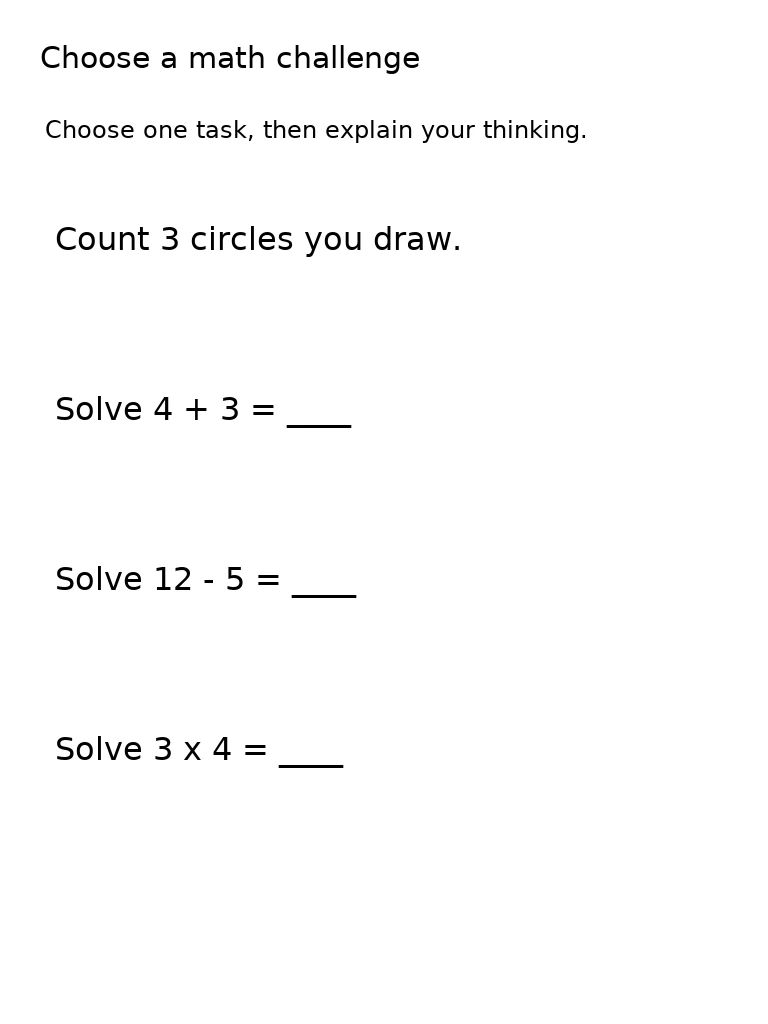
- Explain a chosen challenge — Kindergarten–Grade 4. Objective: communicate a strategy. Materials: comparison companion and suitable tools. Choose one task, solve, explain with words or drawings, then decorate. Check with its key and the explanation. Resource: Choose a math challenge; the artwork remains visually easy.
Free printable math worksheets
The ten companions below come from generated and checked files, not placeholder links. Pages with fixed answers include a separate answer-key page in each PDF; keep that page aside when printing for students. The preview shows the student sheet. A4 and Letter files preserve the same task and answer content.
Live preschool, kindergarten, and worksheet collections may provide additional pictures for adult-added tasks, but a picture collection is not automatically a math worksheet set. No Math learning pack is claimed here. Use the Alphabet & Number guide for earlier letter and small-quantity activities, and the Teacher Resource Centre for existing broader resources.
Before using any adapted worksheet, verify every problem, key, and stated range. A sum “within twenty” should have a total no greater than twenty; subtraction should not accidentally require negative values when the lesson assumes whole-number results. Mathematical correctness is a prerequisite, while coloring remains optional.
Frequently asked questions
What are math coloring worksheets?
They combine a mathematical task with coloring or another visual response. The task might be counting, solving, sorting, or continuing a pattern; ask students to explain the math rather than judging neatness.
How can teachers use color-by-number math activities?
Check that every answer maps to exactly one key entry, solve before coloring, and allow written labels or patterns as alternatives. Use the answer page to verify results.
Are math coloring worksheets useful for kindergarten?
They can support small-set counting, numeral matching, shapes, and simple patterns alongside objects and conversation. Choose tasks that fit the learner rather than a grade label alone.
How do you make addition coloring activities?
Write a small set of sums, calculate each answer, and make an unambiguous key or allow free color choices. Validate the task before giving it to students and include a way to check answers.
What math coloring activities work for Grade 2?
Depending on readiness, use addition and subtraction within twenty, comparison stories, repeating patterns, or early equal-group work. Keep visual complexity separate from arithmetic challenge.
Where can I download free math coloring worksheets?
The ten companions below have free A4 and Letter PDFs. Fixed-answer tasks include key pages. No separate math learning pack is currently promised.
Research and further reading
Further reading from research and professional guidance. Study findings apply to their participants and tasks; professional guidance is not the same as a controlled experiment.
- NAEYC: Dot Card and Finger Games
Concrete games support quantity conversations; coloring is a supplemental representation.
- NAEYC: Number Path Games
Practical number-path play connects counting order and numerals.