
By DoodleLearn · Evidence-informed guide
A weather coloring lesson works best when it starts with the world outside the worksheet. Look safely through a window, describe the sky, notice moving leaves, or consult a trusted local report. Then choose a picture or diagram that helps children communicate what they observed. A sun colored yellow is an artistic choice; the day’s actual conditions require evidence.
This guide brings together daily weather, seasons, clouds, and water movement for preschool through elementary activities. Approximate age and grade suggestions are included, but vocabulary and recording demands can be adjusted. Children can speak, point, draw symbols, or dictate to an adult. Do not make writing ability the gatekeeper for a science conversation.
The companion pages below include a labeled water-cycle model, cloud comparisons, a five-row weather diary, clothing choices, seasonal trees, and observation boxes. Existing Weather & Storms and Water Cycle packs remain available separately. Preview each resource and select only the pages that match your objective; an entire pack need not be completed in one sitting.
Coloring offers opportunities for practice and enjoyment. The research does not make every benefit certain, and coloring is not a substitute for instruction, therapy, or medical care.
Download Classroom PrintablesIntroduction to weather and seasons
Weather describes atmospheric conditions at a particular place and time, such as rain, temperature, cloud cover, and wind. Seasons describe recurring parts of the year connected with Earth’s changing orientation as it orbits the Sun. A single rainy day does not define a season, and a single warm day does not establish a climate pattern.
Begin with everyday vocabulary and one observation. Ask “What can we see?” before “What do we think will happen?” Record a prediction separately from a result. Children can color a symbol to summarize an observation, but their explanation should say why they selected it. Return to the same question another day to compare evidence.
Learning about different types of weather
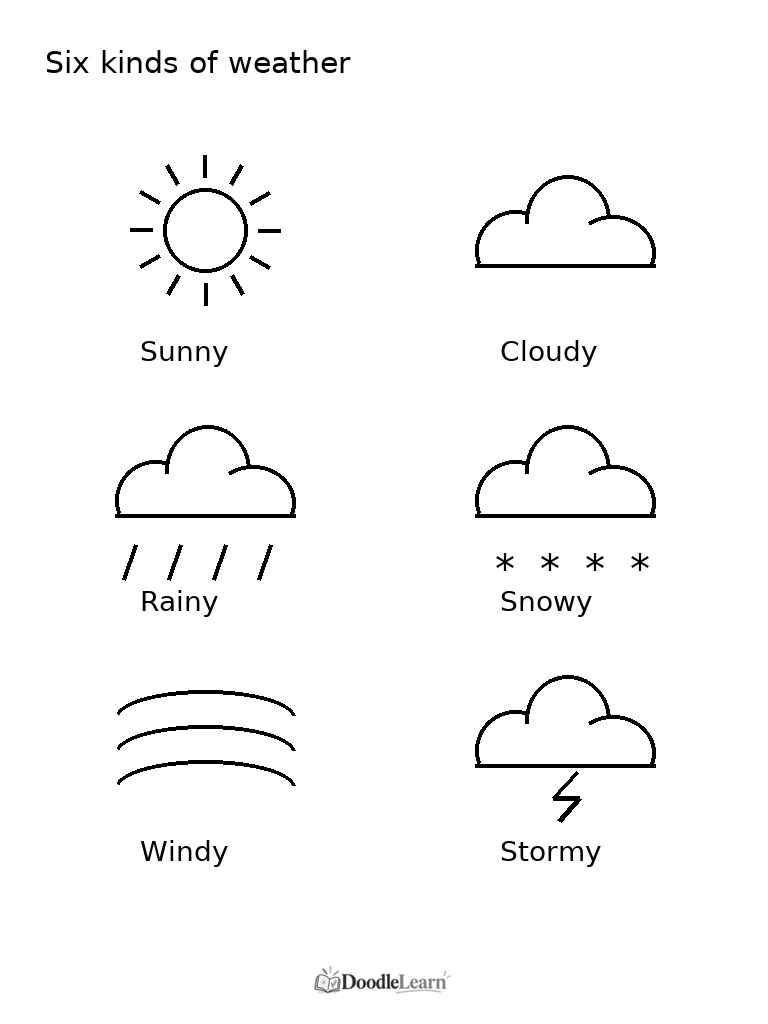
Sunny and cloudy refer to sky conditions, while rainy and snowy describe forms of precipitation. Windy describes moving air; stormy is a broad everyday term for unsettled conditions that can include hazardous weather. These categories can overlap. A windy day may also be sunny, and rain can fall while part of the sky looks bright.
For sunny weather, color a sun symbol and discuss light without looking directly at the Sun. For cloudy weather, outline the cloud areas actually visible from a safe place. For rain, draw short strokes beside the rainy symbol after observing drops or wet surfaces. For snow, compare a picture of snow crystals with an observed snowy scene; the six-armed symbol is simplified, not the exact shape of every snowflake.
For wind, look for moving branches, flags, or other effects rather than expecting air to be visible. For storms, stay indoors and follow local safety instructions. Never send students out to watch lightning or severe weather, and do not teach them to shelter beneath a tree. A weather report can provide information when direct observation is unsafe.
The four seasons
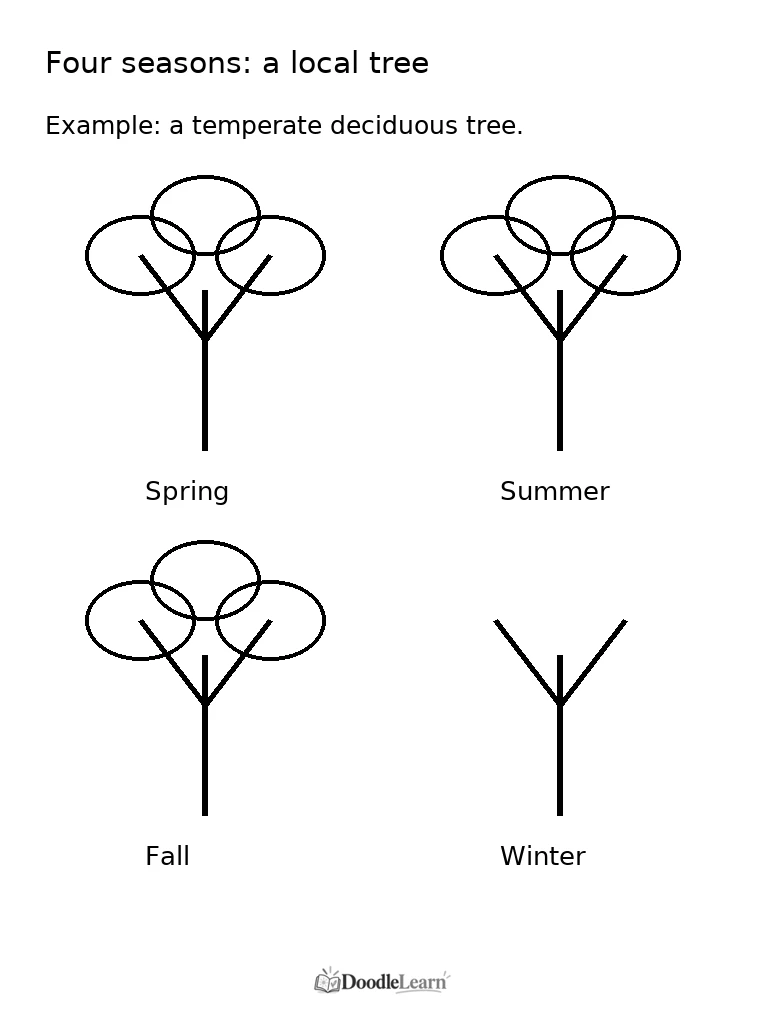
Spring, summer, fall, and winter are familiar seasonal divisions in many temperate regions. Earth’s tilted axis changes the angle and duration of sunlight as it orbits the Sun; seasons are not caused by Earth being closer to the Sun in summer. The Northern and Southern Hemispheres have opposite seasonal timing.
Local patterns vary. Some places have distinct wet and dry seasons, little annual temperature variation, or conditions that do not resemble a temperate four-tree worksheet. Evergreen trees do not lose all their leaves on the same schedule as deciduous trees, and not every animal migrates or hibernates. Label the companion as an example of a temperate deciduous tree, then compare it with actual plants nearby.
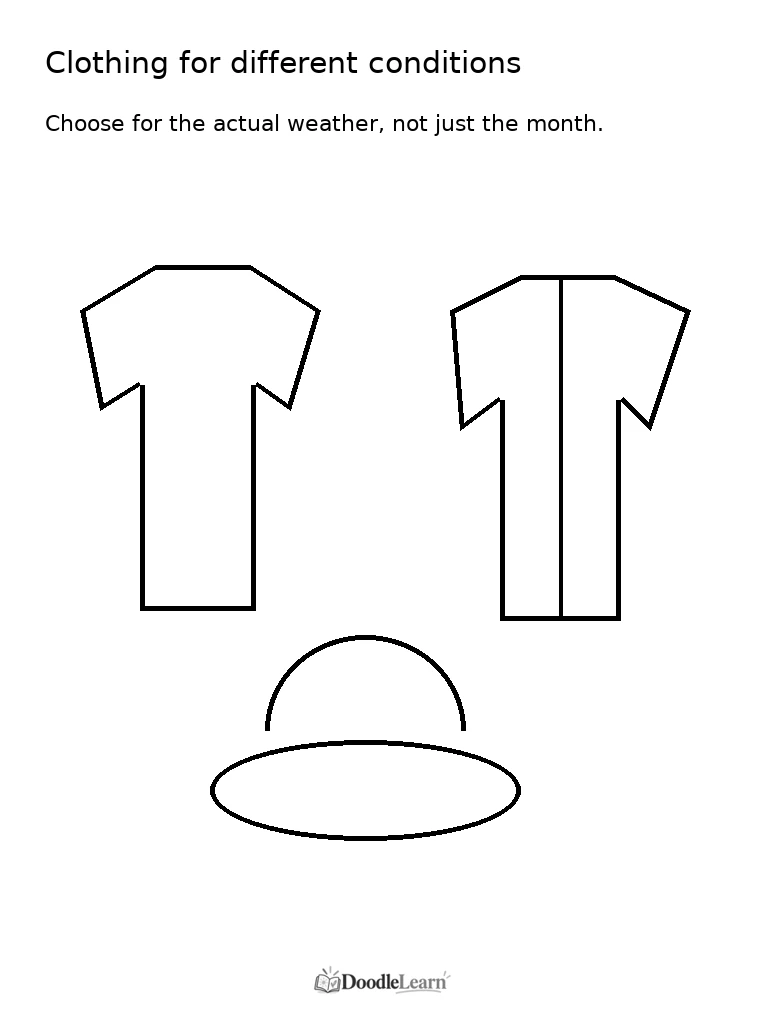
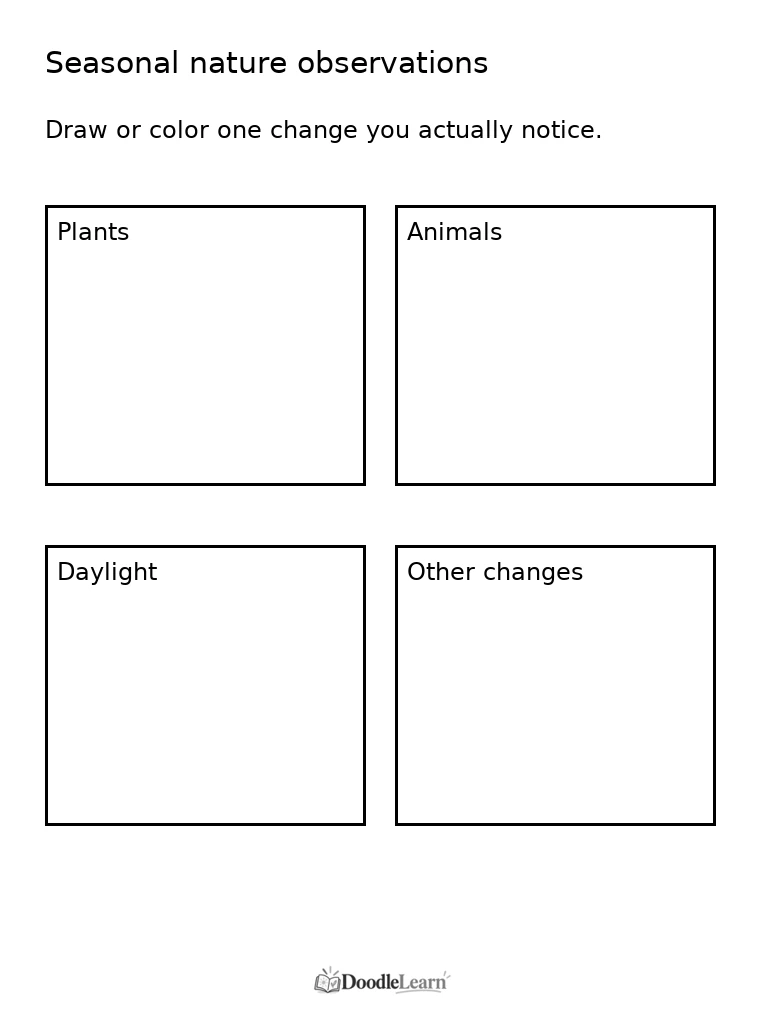
Use changes in daylight, plant growth, animal behavior, and common activities as observation prompts. Clothing choices should follow actual temperature, sun, rain, and other conditions rather than the month alone. Invite families to share the seasonal terms and experiences they use without treating a snowy winter as the only correct winter.
The water cycle
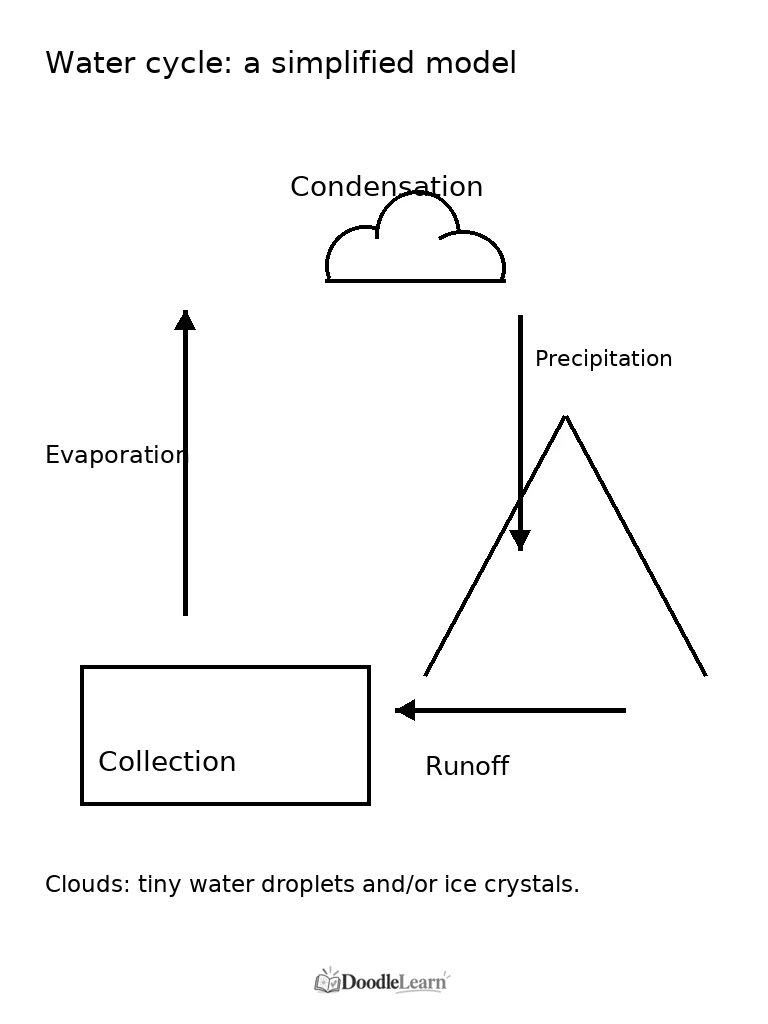
Evaporation is liquid water becoming water vapor, a gas. It can occur without boiling. Condensation is water vapor changing into liquid droplets; in clouds, tiny droplets, ice crystals, or both may be present. Precipitation is water falling from the atmosphere as rain, snow, or other forms. Collection is a classroom term for water gathering in rivers, lakes, oceans, or other places.
The new companion is a simplified pathway model. Its evaporation arrow points upward from collected surface water, precipitation points downward from the cloud, and runoff points toward the collected water. Label these movements and follow one possible route. Do not imply that every water molecule travels around one neat circle: water can enter soil, move underground, freeze, or remain stored for a long time.
Invisible water vapor is not the visible white cloud. Color can distinguish processes, but labels and spoken explanations should carry the meaning as well. The existing Water Cycle pack provides additional vocabulary and tasks; this companion offers a clearly labeled discussion model, not a complete hydrological map.
Clouds and weather
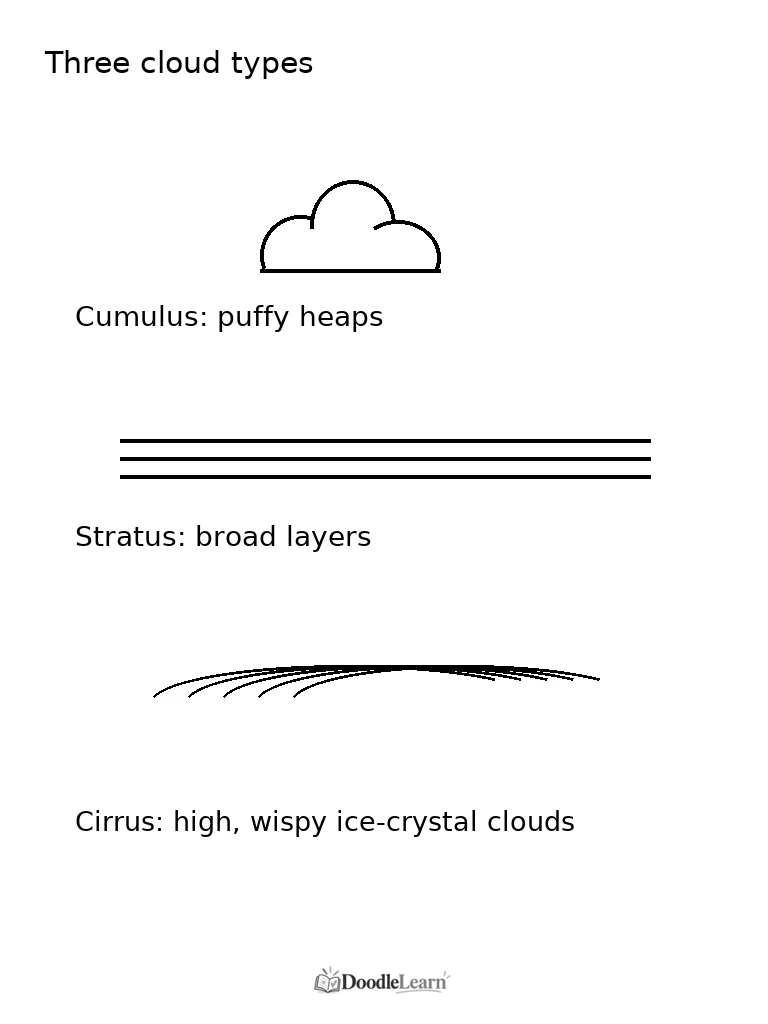
Cumulus clouds often look like puffy heaps; stratus clouds form broad layers; cirrus clouds are high, wispy clouds made of ice crystals. These names introduce shape patterns rather than three boxes that cover every cloud. Real skies can contain different cloud types at once, and a drawing alone is not enough to predict a specific storm.
Compare the labeled companion with reliable photographs and a safe sky view. Ask children which features support a tentative match: a flat layer, rounded heaps, or thin wisps. Allow “I’m not sure” when the view is unclear. Do not claim all cumulus clouds mean fair weather or all layers mean rain; cloud development and other conditions matter.
Rain, snow, and wind activities
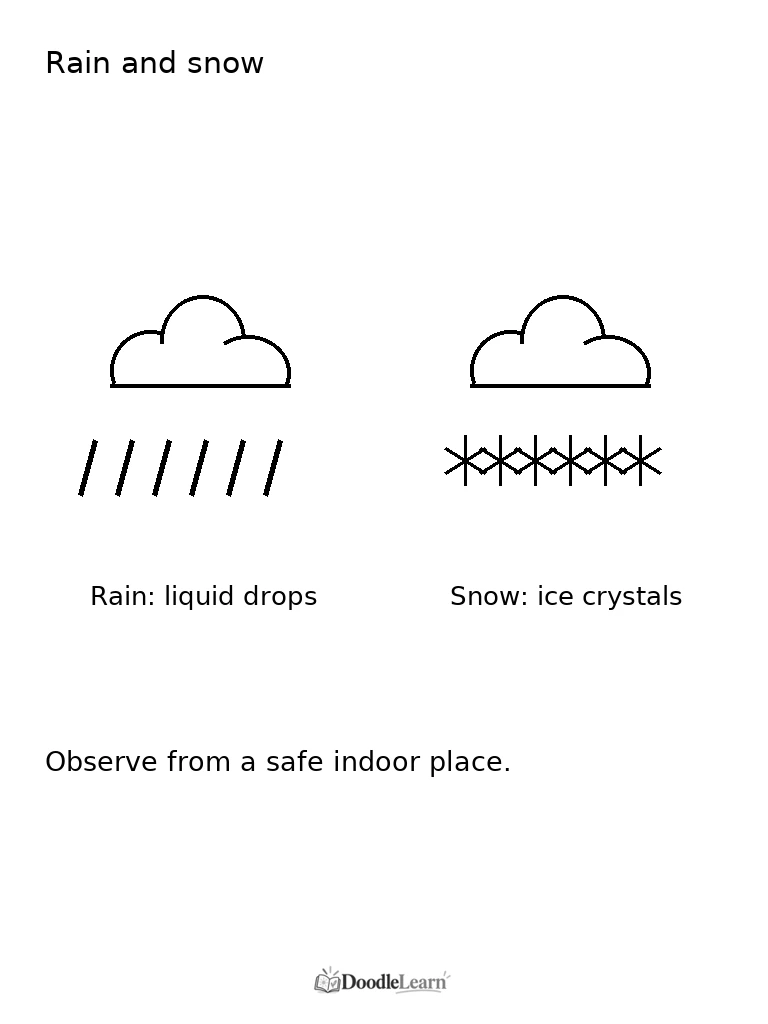
Use the rain-and-snow comparison to distinguish liquid drops from ice crystals. A snowy surface can later melt, but temperature alone at ground level does not explain every precipitation event. Keep early explanations simple without asserting that every cold day produces snow or every cloud produces rain.
A paper wind-evidence activity needs no outdoor equipment: draw a flag, branch, or ribbon as seen from indoors and describe its movement. If using a weather instrument, an adult selects and safely operates it. Classroom demonstrations should not involve boiling water, hot glass, or unsupervised electricity. Discuss what a model shows and what it cannot reproduce.
Weather observation activities
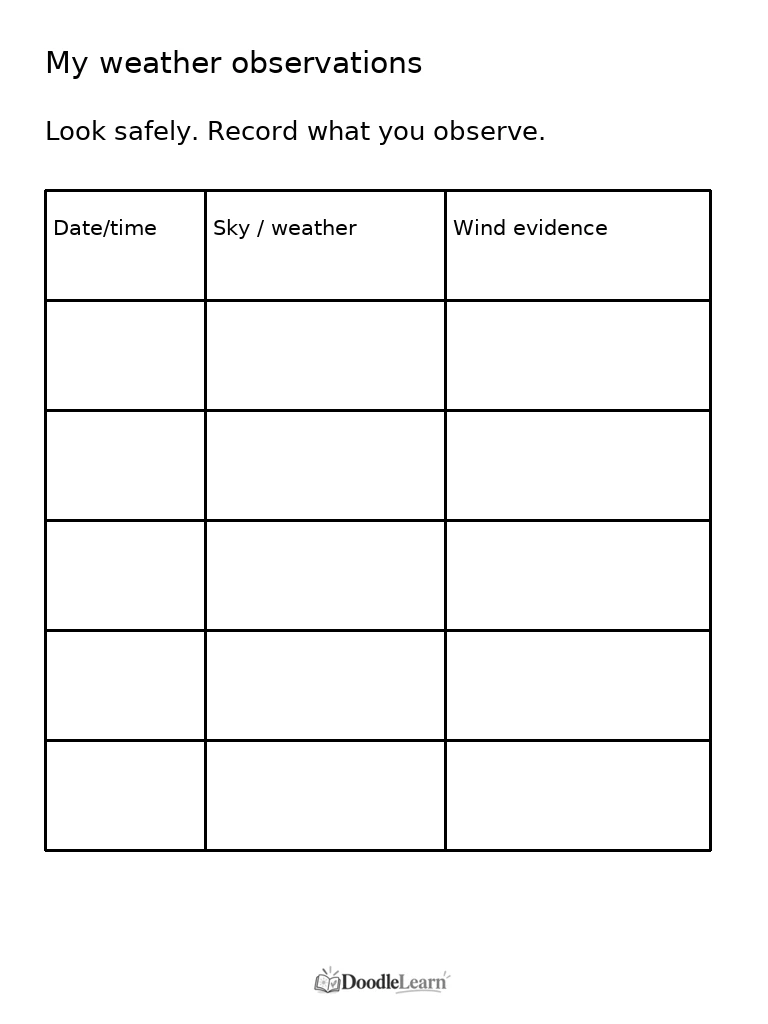
The five-row diary has columns for date/time, sky or weather, and wind evidence. Record at roughly the same time on several days when practical. Write “not observed” if the view is blocked, and distinguish a weather-app report from something the group actually saw. Missing observations are more honest than guessed entries.
After several entries, count categories or compare descriptions without drawing broad conclusions about climate. Ask whether the observation time or location changed. A teacher can add temperature readings separately when a suitable instrument or trusted report is available; the companion does not include a printed temperature scale.
Ten weather coloring activities
Each activity has an approximate age or grade, a focused objective, materials, a short procedure, a discussion question, and an actual resource. Keep hazardous-weather observation indoors and allow labels, patterns, or spoken explanations alongside color.
- Sky-symbol match — Ages 3–5. Objective: connect a symbol to an observation. Materials: weather comparison, crayons, safe window view. Describe the sky, select one or more fitting symbols, and color them. Ask: “What did you see that supports your choice?” Resource: Six kinds of weather companion.
- Two conditions together — Kindergarten–Grade 1. Objective: recognize overlapping weather descriptions. Materials: comparison companion and blank paper. Choose a day that is rainy and windy or sunny and windy, then combine symbols. Ask: “Can both descriptions be true?” Resource: weather comparison.
- Cloud shape detective — Grades 1–3. Objective: compare cloud features. Materials: cloud-types companion, reliable photographs, pencils. Outline a matching shape and label the feature noticed. Ask: “What makes you think it is layered or puffy?” Resource: Three cloud types companion.
- Five-day diary — Kindergarten–Grade 3. Objective: record evidence consistently. Materials: weather diary, pencils, safe window view. Date each entry and record actual sky and wind evidence over five observations. Ask: “Which entry was a report rather than a direct observation?” Resource: weather diary companion.
- Rain or snow — Kindergarten–Grade 2. Objective: distinguish liquid drops from ice crystals. Materials: comparison page and weather photographs. Color one form, label its state, and discuss observed conditions. Ask: “What might happen when snow warms?” Resource: Rain and snow companion.
- Wind without seeing air — Grades 1–3. Objective: identify effects of moving air. Materials: weather comparison, diary, pencils. From indoors observe a flag or leaves, draw their movement, and record it. Ask: “What evidence suggests wind?” Resource: diary and windy symbol.
- Follow surface water — Grades 2–4. Objective: explain one water pathway. Materials: water-cycle companion and two pencils. Trace upward evaporation, downward precipitation, and runoff to collection using labels and colors. Ask: “Where could water remain stored?” Resource: labeled water-cycle companion.
- Weather clothing choice — Ages 4–7. Objective: justify a choice using conditions. Materials: clothing companion and a trusted local report. Color a suitable garment and explain the observed condition behind the choice. Ask: “Would the month alone tell us what to wear?” Resource: clothing companion.
- Compare two diary days — Grades 1–3. Objective: identify a documented difference. Materials: completed diary and pencils. Circle words or symbols that differ across two entries and explain them. Ask: “Did we observe at the same time?” Resource: five-row weather diary.
- Safe storm discussion — Grades 1–4. Objective: distinguish learning from hazardous observation. Materials: Weather & Storms pack, pencils, adult guidance. Select a safety page, discuss indoor observation, and follow local instructions. Ask: “What should we do when observation is unsafe?” Resource: actual Weather & Storms pack; never go outside to watch lightning.
Ten seasons coloring activities
Use these as invitations to notice local change. Seasons are context, not guarantees about a particular day. Materials are the relevant seasonal companions, pencils, blank paper, and safe observations or reliable photographs.
- One tree over time — Ages 4–7. Color the four-season tree example, then compare it with one real tree across available photographs. Objective: notice change. Ask: “Which parts match our tree?” Resource: Four seasons companion; explain its temperate deciduous setting.
- Spring plant watch — Kindergarten–Grade 2. Draw a new bud or flower actually observed, then color the plants box. Objective: separate an observation from an expectation. Ask: “What changed since last time?” Resource: Seasonal nature observations companion.
- Summer shade choices — Ages 4–7. Choose clothing for a warm sunny report and discuss shade and adult guidance. Objective: use conditions in decisions. Ask: “What else besides temperature matters?” Resource: Clothing companion. Do not look at the Sun.
- Fall leaf comparison — Grades 1–3. Compare reliable leaf photos or safely collected familiar leaves with adult supervision. Color different observed tones and note the tree. Objective: notice variation. Ask: “Do all trees change alike?” Resource: seasonal tree and observation boxes.
- Winter without snow — Kindergarten–Grade 3. Draw a local winter scene using actual conditions, even if there is no snow. Objective: resist a one-place stereotype. Ask: “What tells us about winter here?” Resource: seasonal observation boxes.
- Daylight conversation — Grades 2–4. Compare trusted local sunrise and sunset information from two times of year, then add a note in the daylight box. Objective: identify changing daylight duration. Ask: “What location are these times for?” Resource: observation boxes.
- Animal observations — Ages 4–8. Record a bird or insect seen safely, without assuming migration or hibernation. Objective: describe before explaining. Ask: “Did we observe it or hear about it?” Resource: seasonal-nature animals box; avoid disturbing wildlife.
- Opposite hemispheres — Grades 2–4. Use a globe or adult explanation to compare seasonal timing north and south of the equator. Objective: recognize geographic differences. Color two contrasting seasonal scenes. Ask: “Is our summer everyone’s summer?” Resource: Four seasons companion.
- Garden season story — Ages 4–7. Select a real nature picture and tell what might change locally over time, labeling prediction separately. Objective: distinguish possibility from evidence. Ask: “What would we need to observe?” Resource: seasonal-nature companion and live nature collections.
- Local season gallery — Kindergarten–Grade 4. Display observations from different families or places with permission, without personal location details. Objective: compare experiences respectfully. Ask: “Which similarities and differences do we notice?” Resource: four-season and observation companions.
Free weather and seasons printables
Print the companions in the paper size that matches your printer, and check the preview before using them. Weather & Storms offers further cloud, storm, and weather-tool activities. Water Cycle focuses on water movement and related vocabulary. The new seasonal companions support broader seasonal comparison. The pack links below come from actual pack records rather than invented worksheet titles.
For a short session, select one observation chart or diagram instead of a whole stack. The existing pack covers and internal sheets remain their own resources; the new diagrams do not silently replace previously downloaded pack pages. Use the guide’s labeled companion when you want the exact arrow model discussed above.
Classroom and homeschool tips
Give each lesson a question, an observation, a representation, and a conversation. Let students annotate their picture with a word, pattern, or dictated sentence so meaning does not depend on color alone. Revisit an idea after another observation and encourage revision: changing an explanation in response to evidence is part of learning.
For mixed ages, share the same sky view but vary the record. A younger child chooses a symbol; an older student writes a claim and its evidence. Use accurate vocabulary without requiring every term at once. Check local safety advice, accommodate sensory and mobility preferences, and make participation possible from an indoor seated position.
Frequently asked questions
How do you teach weather to kindergarten students?
Begin with a safe observation, name one or two visible conditions, and record a symbol or dictated sentence. Compare another day and ask what evidence supported the description.
What are the four seasons?
Spring, summer, fall, and winter are common seasonal divisions in temperate regions. Their timing and local conditions differ by hemisphere and location; many places use other seasonal patterns.
How can coloring activities help children learn about weather?
A symbol or diagram can help children record, compare, and discuss observations. The science comes from accurate explanations and evidence, not from choosing a particular color.
What is an easy way to explain the water cycle?
Describe liquid water becoming vapor, vapor forming droplets, water falling as precipitation, and water gathering or moving elsewhere. Trace one pathway while explaining that water also has other routes and storage places.
What are good weather activities for preschoolers?
Match a sunny or rainy symbol to a safe window view, notice wind effects, or dictate an entry in the diary. Keep the task brief and allow pointing instead of writing.
Where can I find printable weather worksheets?
The eight companions below are free in US Letter and A4, alongside links to the real Weather & Storms and Water Cycle learning packs.
Research and further reading
Further reading from research and professional guidance. Study findings apply to their participants and tasks; professional guidance is not the same as a controlled experiment.
- PBS KIDS: Exploring Weather
Practical weather charts connect observations, patterns, and local seasonal discussion.
- National Weather Service: Educational Resources
Official weather education resources, including cloud information and classroom lessons.
- USGS: The Water Cycle
Water movement and storage involve interconnected pathways rather than one compulsory loop.
- NASA Space Place: What Causes the Seasons?
Earth’s axial tilt changes sunlight angle and daylight duration across the year.