By DoodleLearn · Evidence-informed guide
A coloring page can become a useful science tool when students use it to notice, classify, label, or communicate. It cannot replace observing a real plant, testing a prediction, discussing evidence, or checking understanding. Start with a question children can answer through something they see or do; choose a page that helps them record or explain it.
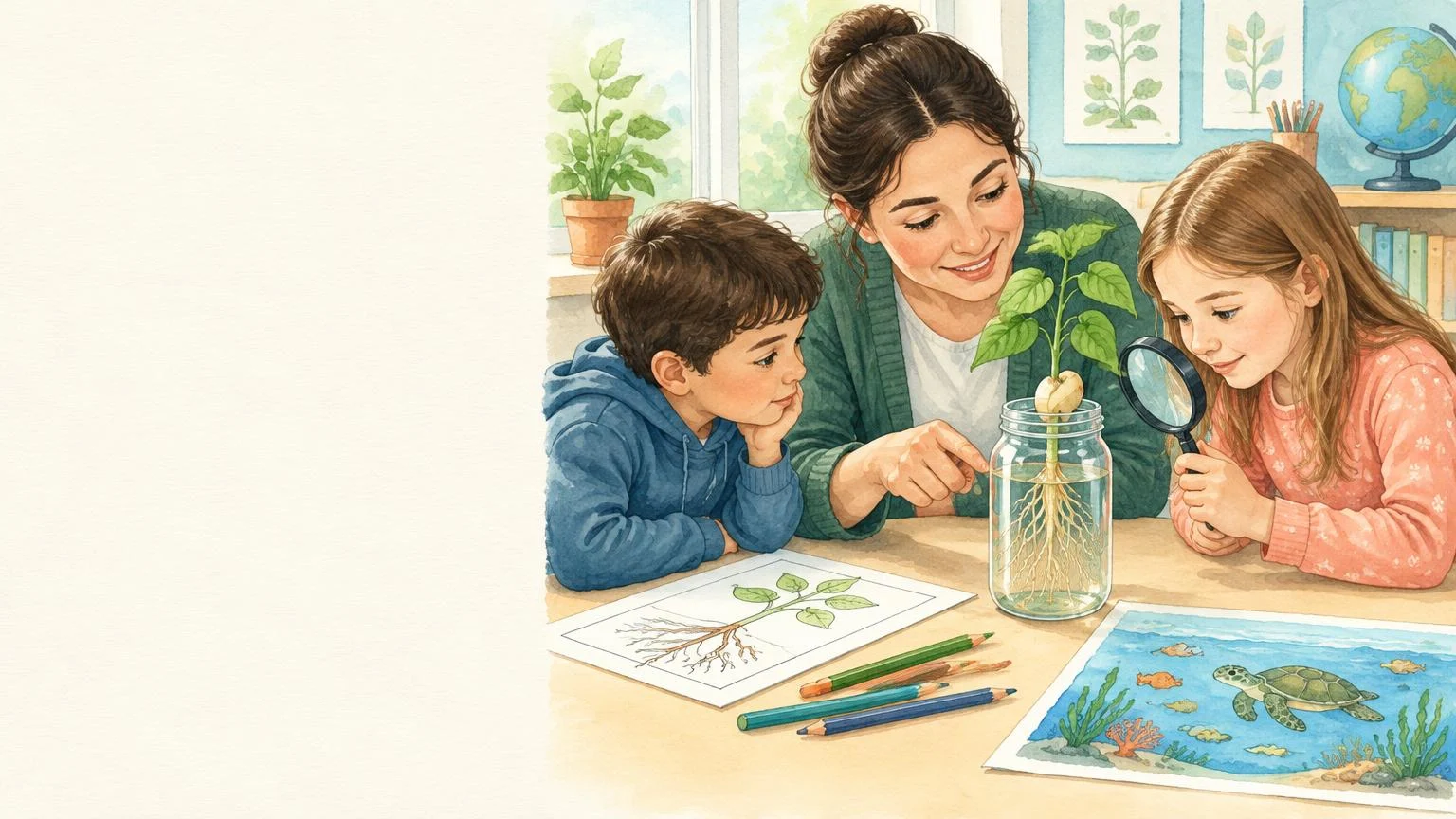
For example, students might observe a seedling, color its visible parts, and explain which parts are above or below the soil. The colors are a communication choice, not evidence by themselves. Ask why they marked an area and what they still wonder. A beautifully finished sheet may conceal a misconception; a rough sketch with a clear explanation may reveal strong understanding.
The lessons below are suggestions for roughly Grades 1–4, with adaptations for younger or older learners. Grade ranges are approximate, not curriculum alignment claims. The real packs provide printable diagrams, vocabulary, quizzes, and answer explanations. Use those pages selectively rather than requiring every child to complete the whole pack in one session.
Coloring offers opportunities for practice and enjoyment. The research does not make every benefit certain, and coloring is not a substitute for instruction, therapy, or medical care.
Download Classroom PrintablesTeaching ecosystems through coloring
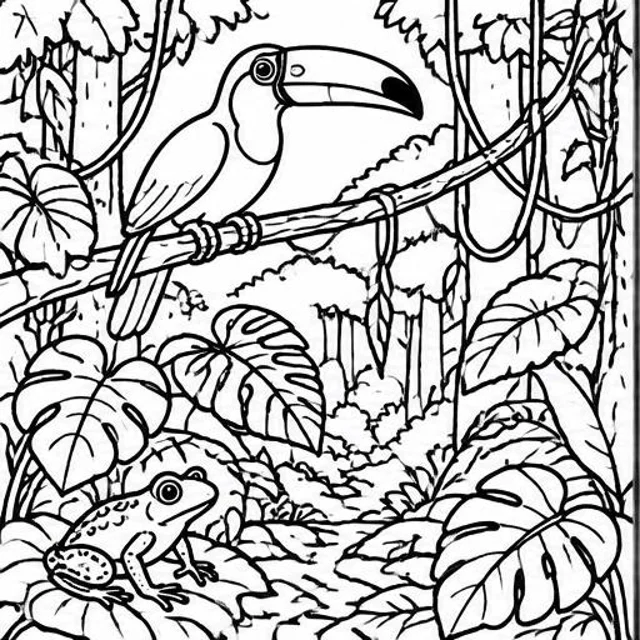
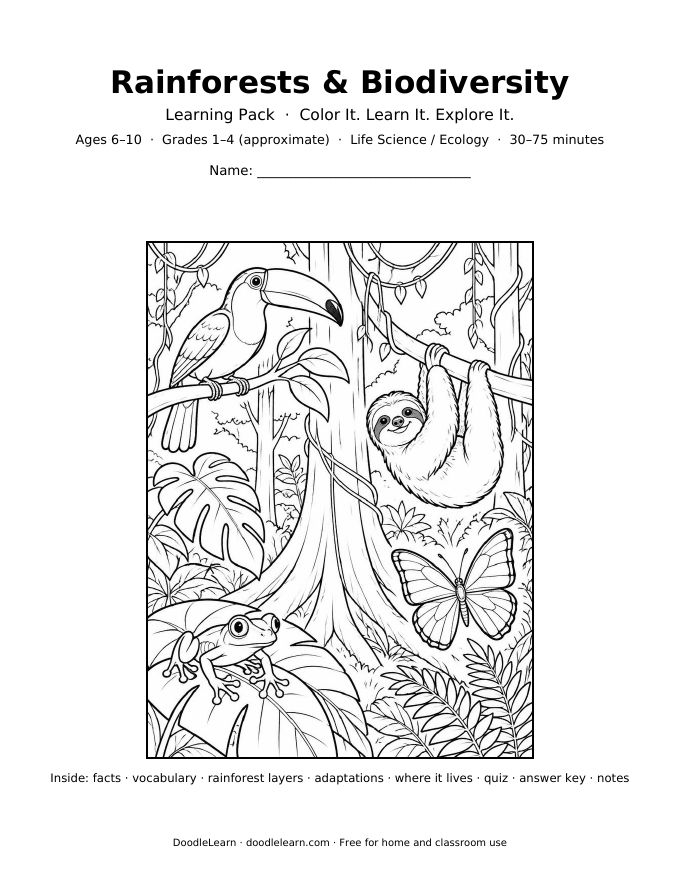
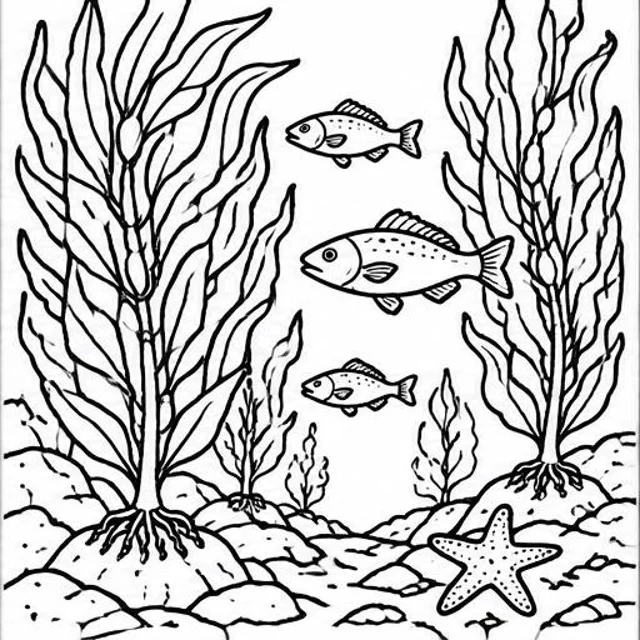
Compare an ocean, rainforest, forest, or desert using a small set of reliable photographs and information. Ask students to identify what organisms need and which habitat features might provide it. A decorative rainforest scene is not a scientifically complete ecosystem model. Discuss what the picture includes, what it leaves out, and whether each animal shown belongs in the habitat being studied.
In a comparison lesson, color water blue on one habitat sheet and underline plant names you add on another. Students then label one possible source of food or shelter and explain a difference. Avoid instructions such as “All deserts are hot” or “Every rainforest animal lives in the canopy.” Habitats vary, and organisms use different parts of them.
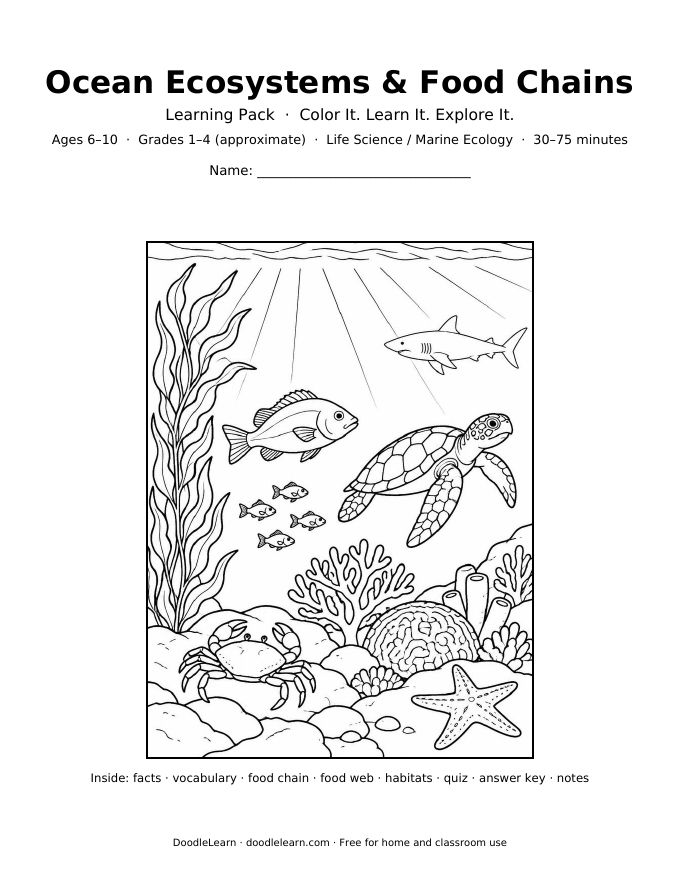
Use the Rainforests & Biodiversity pack for its actual rainforest-layer worksheet and the Ocean Ecosystems & Food Chains pack for its energy-flow diagram. Food-chain arrows point toward the organism receiving energy: food → eater. A food web includes connected feeding relationships rather than one inevitable chain. Do not use color as the only cue; add names, patterns, or spoken explanations.
Plant growth, life cycles, and pollination
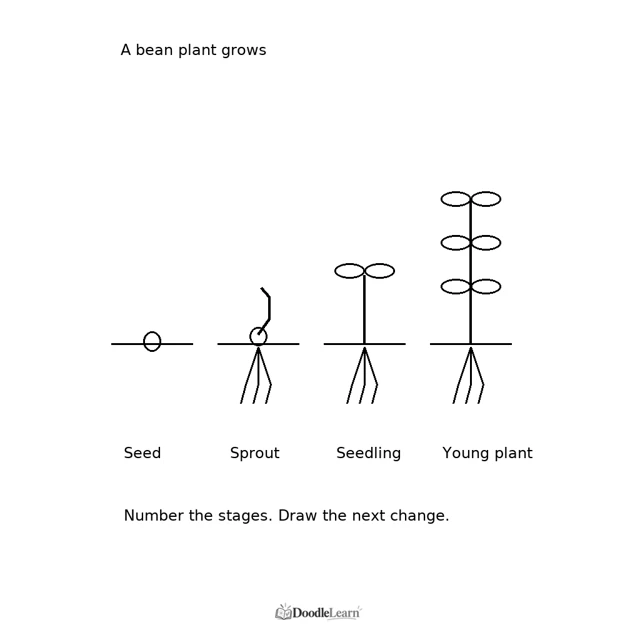
Distinguish germination from pollination. Germination is a seed beginning to grow under suitable conditions; pollination involves pollen reaching the receptive part of a flower. A seed already exists before it germinates. Do not imply that a bee must visit a planted seed before it can sprout, or that every seed needs exactly the same temperature or light conditions.
Observe a bean seedling or reliable sequence photographs, then use the downloadable bean-growth page below. Students number seed, sprout, seedling, and young plant, and draw a later change. This is a growth sequence, not a complete flowering-plant life cycle. To close a life cycle, discuss a mature plant, flowers, fertilization, fruit or seed development, and the next generation where appropriate.
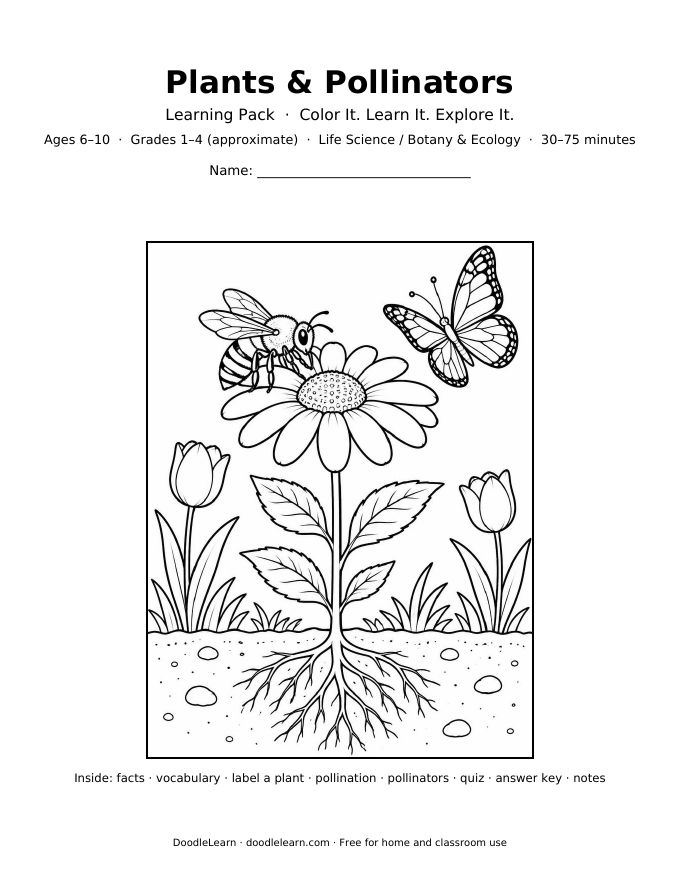
The existing Plants & Pollinators pack contains a plant-parts labeling page and a bee-pollination sequence, not a dedicated seed-to-seed life-cycle worksheet. Pair it with the new growth sequence and a real observation. Ask which changes students saw and which are inferred. Keep unfamiliar plants and soil away from mouths, wash hands afterward, and avoid touching insects.
Weather, seasons, and the water cycle
Use a daily observation, a window view, or trusted weather images to discuss clouds, rain, snow, and wind. Students can add weather symbols to a scene and compare observations from two days. Wind is moving air; a flag or moving leaves can provide evidence of its effects. A colored sun on a worksheet does not tell you the day’s measured temperature.
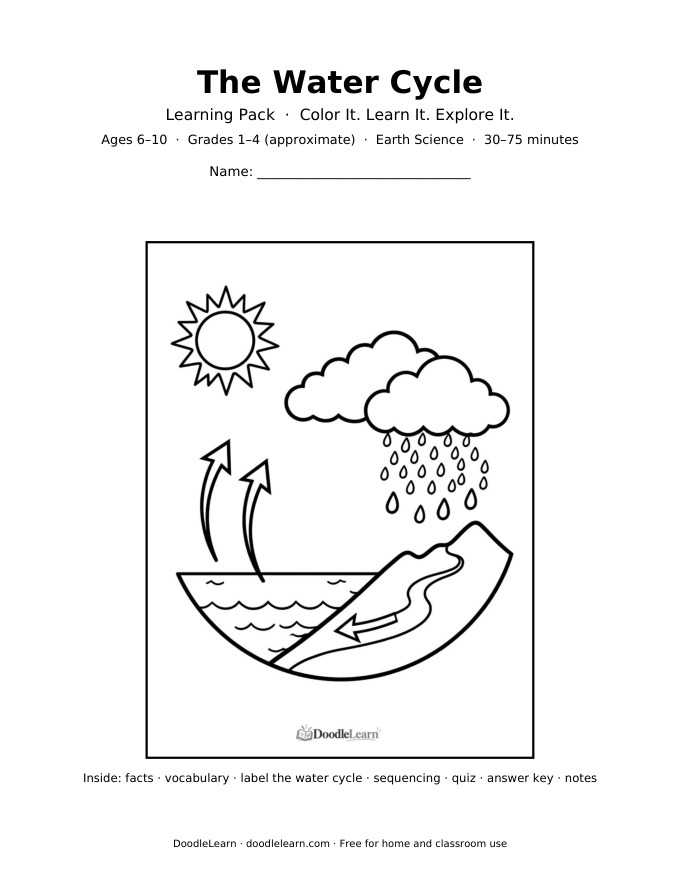
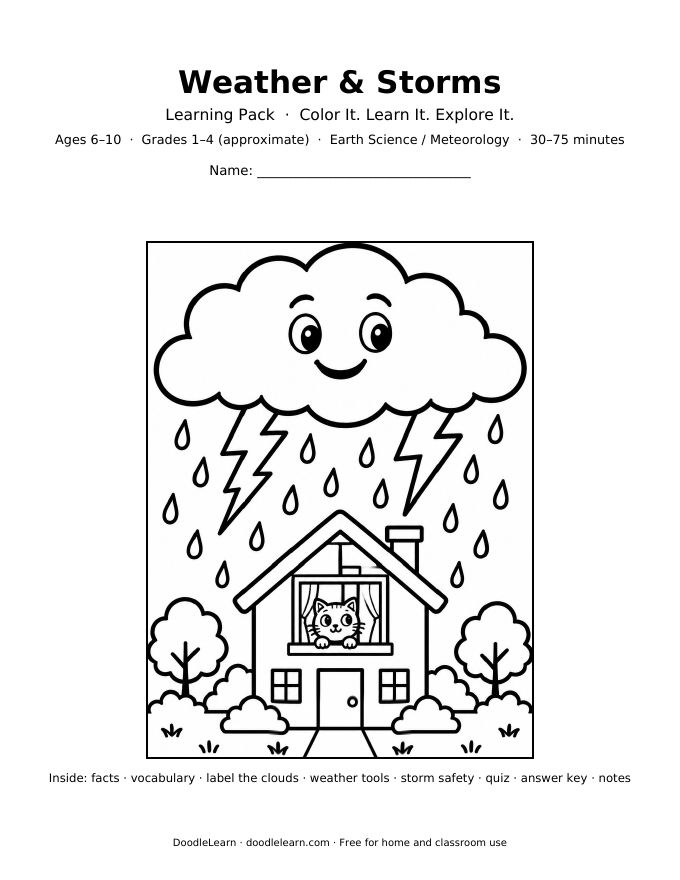
The Water Cycle pack provides a labeling page and sequencing activity. Explain evaporation, condensation, and precipitation as connected processes, not steps every water molecule must follow in one fixed order. Clouds contain tiny liquid droplets, ice crystals, or both; invisible water vapor is not the visible cloud. The Weather & Storms pack adds cloud labels and safe weather observations.
For a classroom activity, color arrows to distinguish movement in a water-cycle diagram, add process names, and explain one pathway aloud. Use labels as well as colors. Compare seasonal patterns locally without claiming the same weather happens everywhere in the same month. Observe storms only from a safe indoor location, and do not use weather activities as a reason to go outside in hazardous conditions.
Electricity and circuits: check the whole loop
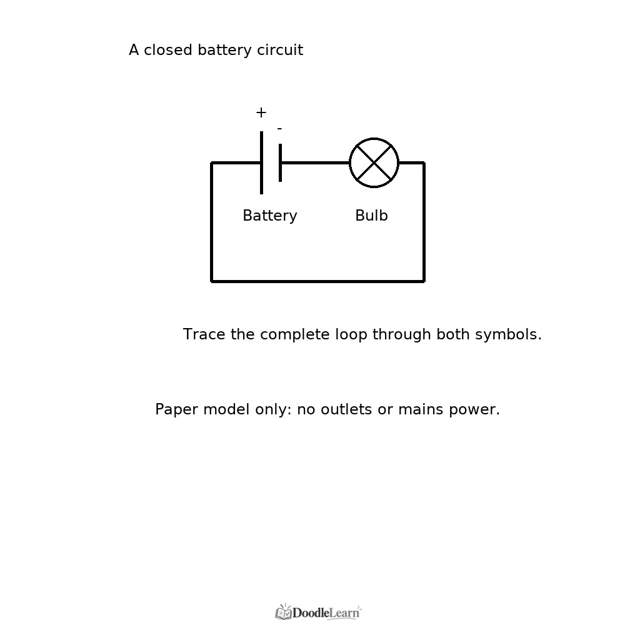
A simple battery-and-bulb circuit needs a complete conductive path between the battery’s two terminals through the bulb’s working connections. An open switch interrupts that path. The battery supplies energy; it does not supply a one-time pile of electricity that travels down one wire and stops at the lamp. Have students trace the entire loop with a finger before coloring it.
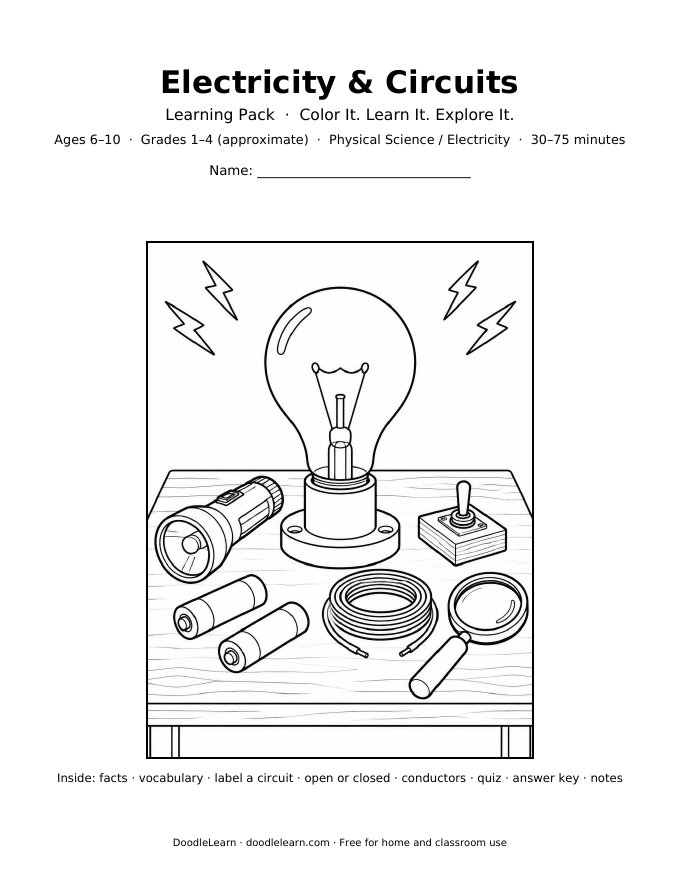
Use the Electricity & Circuits pack’s actual open/closed diagrams and conductor sorting task. Color a continuous wire path, label the battery, bulb, and switch, then explain why one configuration works. The supporting picture here is a simplified closed-loop paper model. It intentionally leaves out wire routing detail and is not a construction instruction.
Keep this lesson paper-based unless a responsible adult selects a suitable low-voltage educational kit and follows its instructions. Never use outlets, mains electricity, opened appliances, damaged batteries, or wires directly connecting both battery terminals without a suitable load. Conductors and insulators are material properties, not guarantees that any object is safe to touch.
Forces and motion: pushes, pulls, and fair comparisons
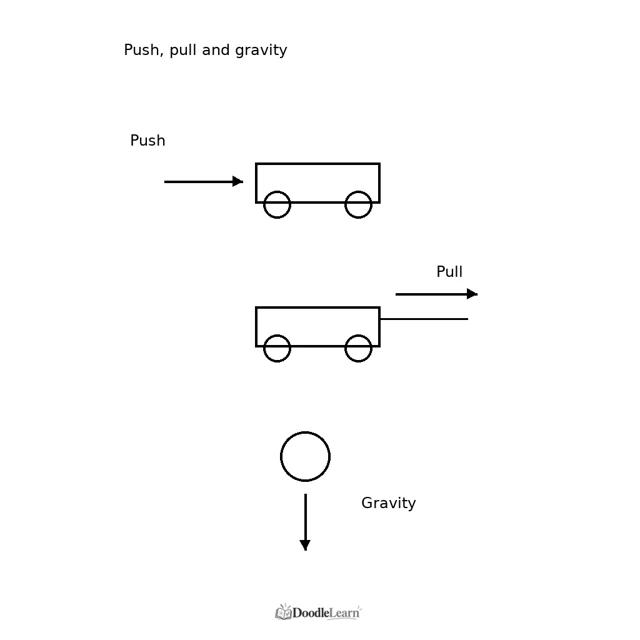
A force is a push or pull arising from an interaction. It can change motion; balanced forces can leave motion unchanged. Gravity acts downward near Earth, including when an object is supported and not falling. Friction can oppose relative sliding or the tendency to slide. Avoid claiming that every moving object needs a continuing push to keep moving.
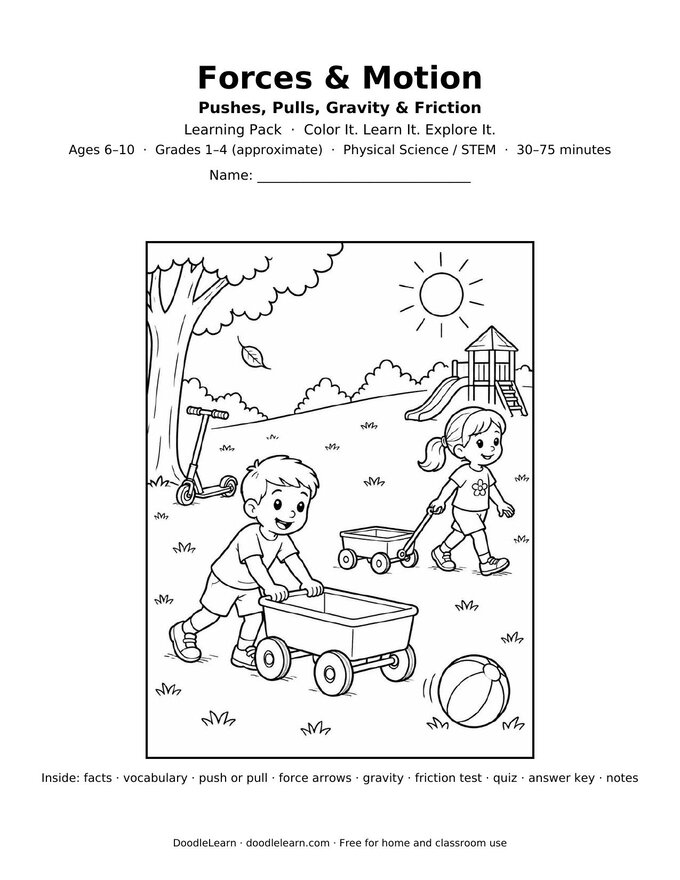
On the Forces & Motion worksheet, students distinguish push and pull situations and add arrows according to the described interaction. An arrow’s direction is meaningful; an illustration of a rolling car does not automatically show every force. Compare a toy car on two surfaces from the same ramp height and release point, keeping the car and measurement method unchanged.
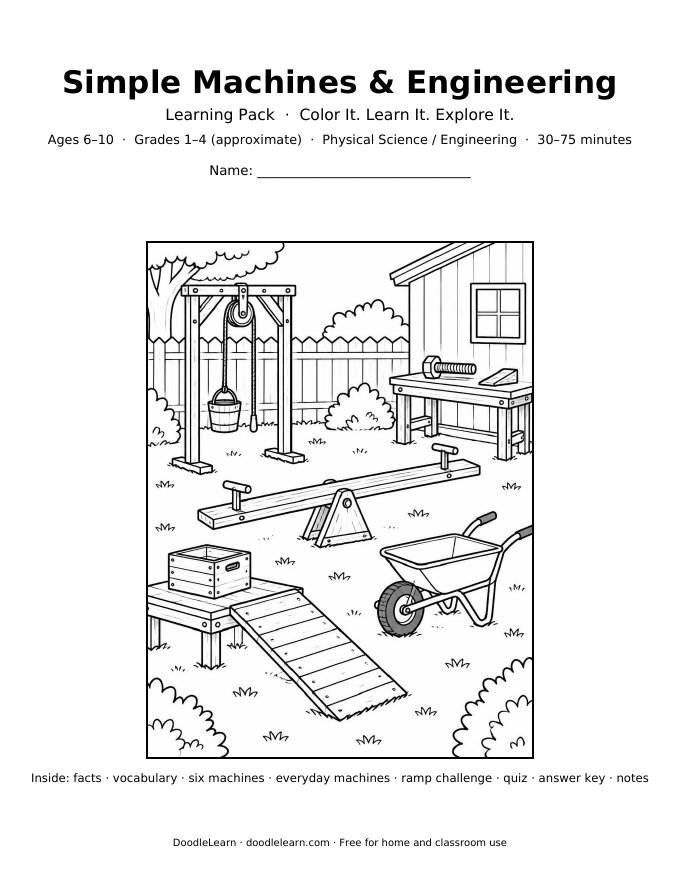
Link this with the Simple Machines & Engineering pack. A ramp can reduce the force needed over a longer distance; it does not create free energy. A machine may change force direction or trade force against distance. Use safe small objects, clear floor space, and adult supervision. Ask students what was held constant and what evidence supports their comparison.
Light and shadows: source, blocker, and surface
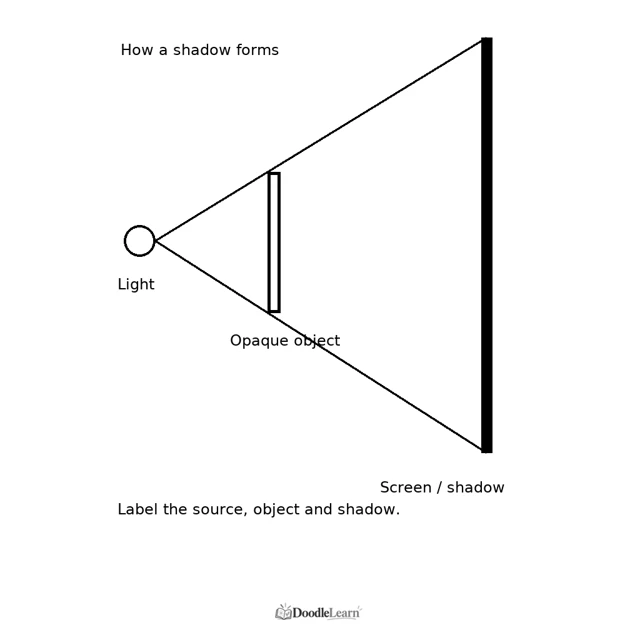
A shadow forms when an object blocks some light from reaching a surface. Identify three things in the printable below: the light source, an opaque object, and the receiving surface. The rays drawn in this model mark the edges of the blocked region; they are not visible beams you normally see in clean air. Other light sources can make real shadows lighter or more complex.
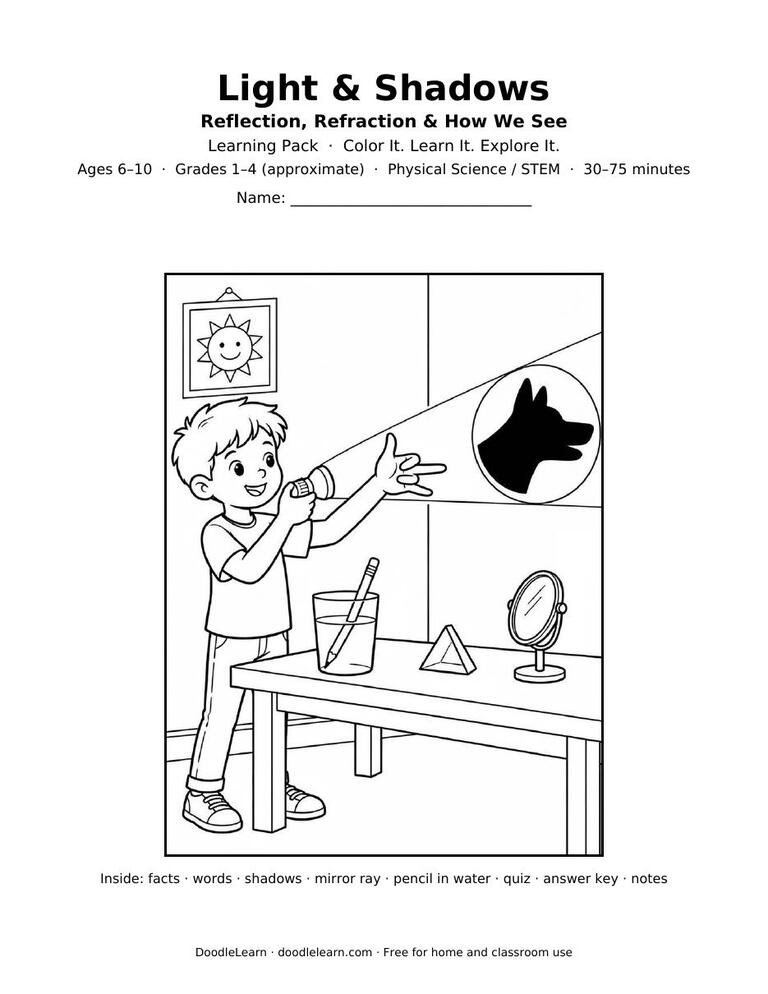
The Light & Shadows pack includes a shadow diagram, size predictions, and a mirror activity. With a small flashlight, a card shape, and a screen, change one distance at a time and compare the shadow. Keep the object and screen aligned; a prediction about getting “bigger” needs a clear statement of which distance changed.
Transparent materials transmit much of the light, translucent materials scatter transmitted light, and opaque materials block transmission. Reflection changes light’s direction at a surface. Use a safe flashlight and avoid pointing bright lights at eyes. Never look at the Sun or use a magnifying glass to concentrate sunlight for this activity.
Sound and vibrations: observe the source
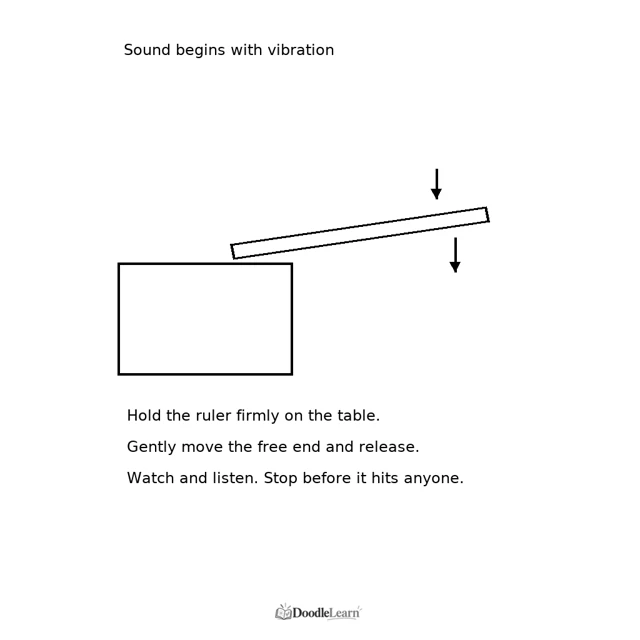
Sound is produced by vibrations and travels through a medium such as air, water, or a solid. It does not travel through a vacuum. In air, sound involves pressure variations rather than a visible ribbon moving across the room. Wave drawings are models; label what they represent before students infer that the air itself travels from a speaker to an ear.
Gently release the free end of a ruler held firmly over a table edge, with an adult controlling the setup. Students can observe the back-and-forth movement and listen at a comfortable level. Compare two overhang lengths while keeping the material and handling similar. Discuss pitch separately from loudness: faster vibration corresponds to higher frequency, while louder sound generally involves greater vibration amplitude in a comparable setup.
DoodleLearn does not currently list a Sound & Vibrations learning pack. There is no placeholder download for it. Use the illustration as a discussion model and ask students to record their observations on blank paper. Keep all demonstrations quiet and away from faces; do not pull tight materials toward someone or produce loud sounds near ears.
Ten ready-to-use science coloring activities
Each lesson below provides an approximate grade range, objective, materials, a short procedure, a question, and a real printable recommendation. Adapt reading and writing demands, offer spoken responses, and use patterns or labels alongside color. Check understanding through explanation rather than completion.
- Habitat comparison — Grades 1–3. Objective: identify food or shelter in two habitats. Materials: rainforest and ocean packs, pencils, reliable photographs. Color and label a feature in each habitat, then compare. Ask: “What need could this feature meet?” Printable: Rainforests & Biodiversity layers and Ocean Ecosystems habitat matching pages.
- Follow energy — Grades 2–4. Objective: explain a food-chain arrow. Materials: Ocean Ecosystems & Food Chains pack and colored pencils. Trace arrows from food to eater, add organism names, and explain one transfer. Ask: “Who receives energy here?” Printable: the pack’s ocean-food-chain worksheet.
- Watch a bean grow — Grades 1–3. Objective: put observed growth stages in order. Materials: bean photographs or a supervised seedling, the new bean-growth sequence, crayons. Number and color the stages, then draw a later change. Ask: “Which change did you observe?” Printable: Bean growth sequencing, below; plant-parts labels from Plants & Pollinators.
- Pollination story — Grades 2–4. Objective: distinguish pollen transfer from seed germination. Materials: Plants & Pollinators pack, pencils, flower photos. Sequence the bee-pollination pictures and explain what moves. Ask: “What happens to pollen?” Printable: the pack’s pollination-steps activity.
- Weather report — Grades 1–3. Objective: describe evidence about today’s weather. Materials: Weather & Storms pack, pencils, a safe window view. Color a cloud diagram and add an observation beside it. Ask: “What did you actually see?” Printable: cloud labeling and weather-tools pages; stay indoors in hazardous conditions.
- A water pathway — Grades 2–4. Objective: explain one possible water-cycle route. Materials: Water Cycle pack and pencils. Label processes, trace one path, and compare another possible path. Ask: “Must all water follow the same route?” Printable: water-cycle labels and sequence page.
- Find the break — Grades 2–4. Objective: identify a complete battery circuit. Materials: Electricity & Circuits pack, two pencils; no live electrical equipment. Trace each paper path and mark a break. Ask: “Can you return to the other battery terminal through the bulb?” Printable: open-or-closed circuit activity.
- Rolling-surface comparison — Grades 1–4. Objective: identify one changed variable. Materials: Forces & Motion pack, toy car, low ramp, two safe surfaces, ruler, adult support. Release from one point and record distances. Ask: “What did we keep the same?” Printable: friction fair-test investigation page.
- Ramp detective — Grades 2–4. Objective: describe a machine’s trade-off. Materials: Simple Machines & Engineering pack, pencils, a safe ramp example or photograph. Color the ramp, identify load and route, and compare two slopes. Ask: “What changes when the route gets longer?” Printable: six-machine identification and ramp challenge pages.
- Shadow prediction — Grades 1–4. Objective: connect a blocked light path to a shadow. Materials: Light & Shadows pack or the new shadow page, flashlight, card shape, screen, adult supervision. Label the source and blocker, make a prediction, then vary one distance. Ask: “Which distance changed?” Printable: shadow diagram and size predictions; never use the Sun.
Free science learning packs and printable diagrams
The section below pulls from DoodleLearn’s existing pack records, including rainforests, oceans, plants, weather, water, electricity, machines, forces, and light. Each listed pack is currently free with no account required and has A4 and US Letter files. Check the actual worksheet preview and teacher notes before selecting pages for a lesson.
Two additional one-page printables connect directly to this guide: bean-growth sequencing and shadow formation. They supplement, rather than replace, the existing packs. Their diagrams are simplified models with stated limits. Sound remains an observation-and-drawing activity because no Sound & Vibrations pack exists in the current catalog.
Frequently asked questions
How can coloring be used in science lessons?
Give the page a clear purpose: record an observation, identify a part, classify examples, or explain a process. Pair coloring with a question, evidence, and discussion.
Are science coloring worksheets useful for elementary students?
They can support a lesson when the picture and task match the objective. A finished sheet does not establish understanding; ask students to explain their choices.
How can teachers make coloring activities educational?
Start with a focused question, inspect the diagram for accuracy, use labels or patterns as well as colors, and end with an explanation or prediction you can discuss.
What science topics work well with coloring?
Plant parts, habitats, weather diagrams, simple circuit paths, and shadow models can work when their limits are explained. Direct observation and safe investigations remain important.
How can science coloring pages be used for homeschooling?
Choose one question and a few relevant pages, add a safe observation, and discuss the result. Adapt reading demands and allow spoken answers instead of completing every worksheet.
Are DoodleLearn science learning packs free?
Yes. The packs listed here are currently free to download in A4 and US Letter, without an account. No Sound & Vibrations pack is currently listed.
Research and further reading
Further reading from research and professional guidance. Study findings apply to their participants and tasks; professional guidance is not the same as a controlled experiment.
- Smithsonian: Plants and Places
Elementary investigations distinguish plant growth from the role of pollination in producing tomatoes.
- Smithsonian: Weaving the Web
Grades 2–5 activity representing energy flow through feeding relationships.
- Smithsonian: Energy
Investigations of battery, bulb, and wire configurations support the closed-circuit explanation.
- Smithsonian: Energy, Forces, and Motion
Uses observable phenomena such as moving and colliding objects as the basis for investigation.
- Smithsonian: Light and Shadows
Supports identifying a light source, blocking object, and changes in shadows.
- Smithsonian: Sound
Elementary evidence-based investigation of how sounds are made.